Session: PD31: Renal Transplantation & Vascular Surgery II
PD31-05: The Canadian Anatomic Kidney Score: quantitative macroscopic assessment versus histological grading in pre-transplant evaluation of donor kidneys
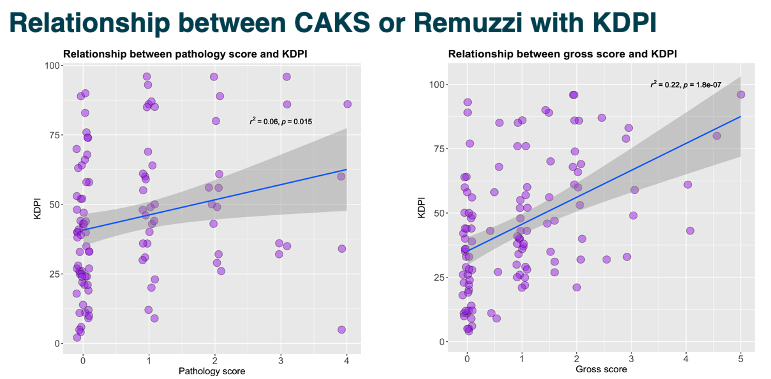
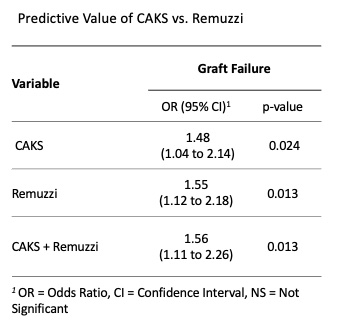
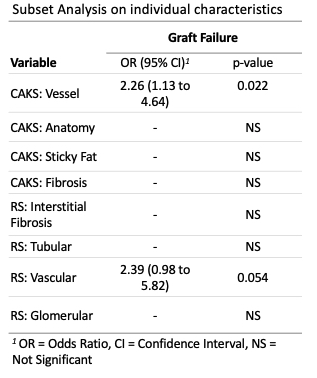
Introduction: The Canadian Anatomic Kidney Score (CAKS) is a novel grading system that provides a framework for macroscopic description of the donor kidney that can standardize communication between clinicians on the quality of the graft. We hypothesize that the CAKS score can independently predict graft outcomes and correlates with KDPI and histologic assessment. Methods: Between 2018-2020, donor kidneys were prospectively evaluated using CAKS by assessing the macroscopic appearance of the kidney. CAKS uses set criteria to evaluate the arterial vessel, parenchymal anatomy (presence of cysts and scars), sticky fat, and fibrosis (up to 2 points each for a maximum of 8). Renal implantation core biopsy was performed and histologically graded by Remuzzi score (RS). Neither CAKS nor RS was used to determine donor utility. Pre-operative donor score was also obtained using KDPI. Graft outcomes were prospectively tracked with graft failure defined by graft loss or GFR <30 at one year. Results: 174 patients were analysed. There was a poor correlation between CAKS and RS (r2 = 0.03). CAKS correlated better with KDPI (r2 = 0.22) than RS with KDPI (r2 = 0.06). On logistic regression analysis, both CAKS (OR 1.48, p=0.029) and RS (OR 1.55, p=0.010) independently predicted for graft failure. On subset analysis, vascular features were the strongest predictors of graft failure for both CAKS (OR 2.26, p = 0.22) and RS (OR 2.39, p = 0.054). Conclusions: The novel CAKS can be used to predict graft outcomes and correlates well with KDPI scores. We seek to evaluate the replicability of CAKS in other centres and potentially develop composite scores to better predict donor graft function in the future. SOURCE OF Funding: None