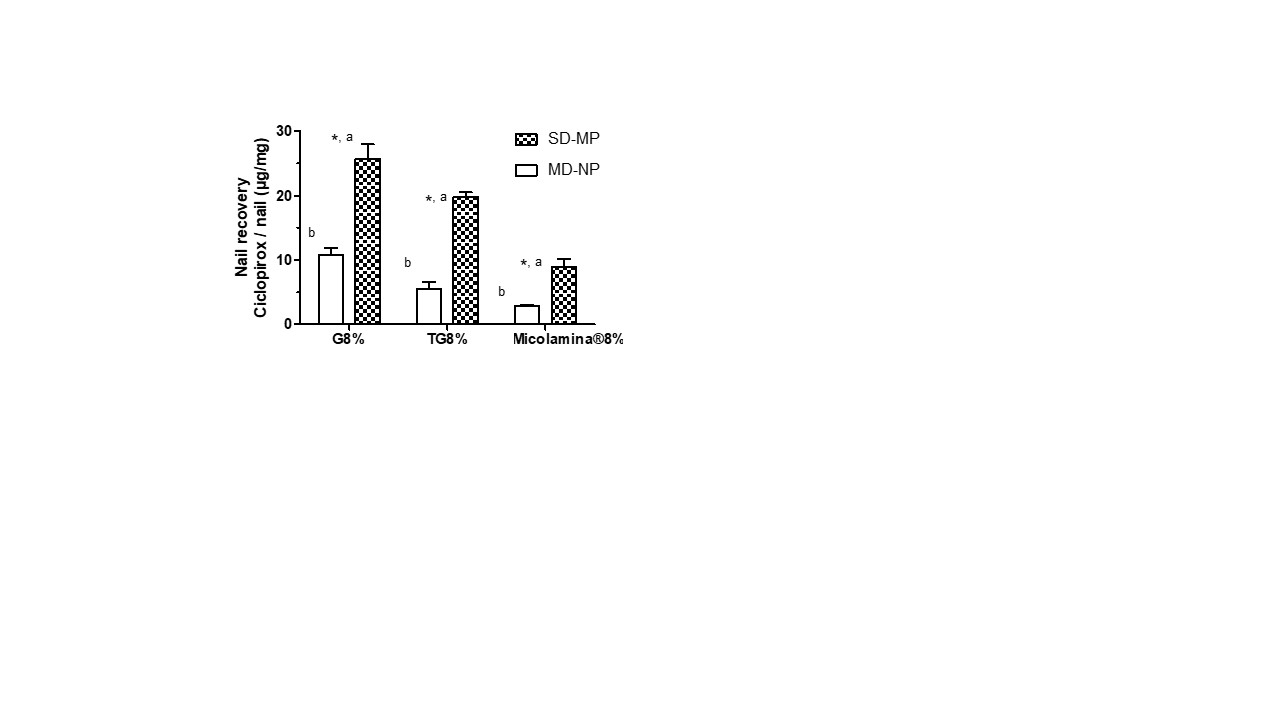
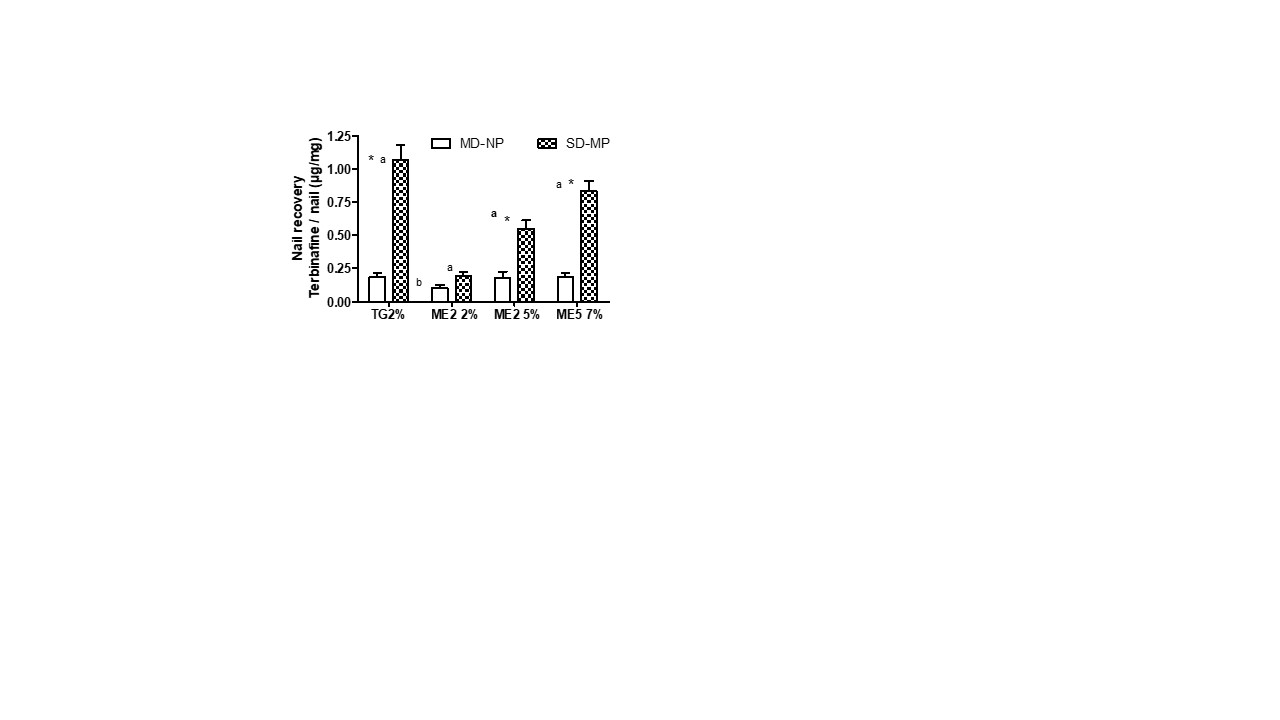
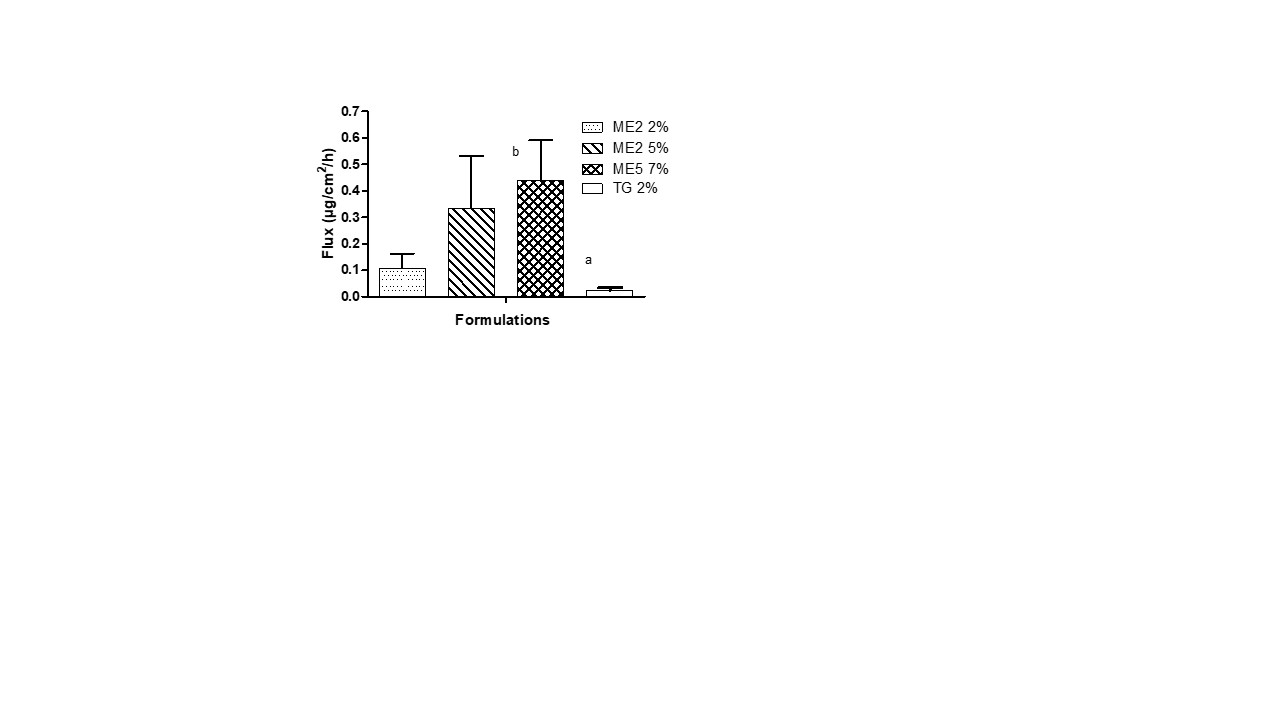
Purpose: Topical treatments for onychomycosis are safer but have limited efficacy1. Medicated lacquers based on blends of organic solvents may leave upon application residues of crystallized, undeliverable drug2. Thus, recent developments have focused on aqueous based lacquers3. Still, it remains challenging for antifungals to attain efficacious levels across the whole nail plate and for patients to adhere to lengthy, daily dosing treatments. This work aimed to develop formulations that (a) provide high solubility for ciclopirox (CPO) and terbinafine (TER) and (b) could be associated to physical (microporation) to improve drug permeation into the nail plate and facilitate dosing regimens Methods: A series of: (a) 2-7% TER microemulsions (ME) containing oleic acid, Cremophor EL, Tween 20, isopropyl alcohol (IPA) and ultrapure water; (b) 2% TER or 8% CPO thermogels (TG) containing poloxamer 407, water, IPA, and propylene glycol, and (c) 8% CPO gels (G) containing hydroxypropylmethyl cellulose, water, IPA, urea and potassium hydroxide were prepared. In vitro permeation tests (IVPT) assessed the performance of these formulations and of the marketed lacquer Micolamina using human healthy nail clippings either porated (Hydra.needle®) or not. IVPTs used vertical diffusion cells with nail adaptors (0.196cm2) and were performed under occlusion at 32±1°C. Single dose – micro porated tests SD-MP applied a 50 µL single dose to porated nails whereas multiple dose – non porated tests (MD-NP) involved daily 10 µL doses. HPLC-UV detection was used to quantify drug in all (7- and 14-days receptor and drug extracted from nails) samples. Results: CPO nail retention in SD-MP tests was increased (p≤0.05) 2.4-3.6-fold compared to MD-NP conditions (Fig.1). CPO was never detected in the receptor in MD-NP tests but measured after 14 days in MD-NP tests: gel (3.83±0.55 µg/cm2); thermogel (3.57± 0.36 µg/cm2) Micolamina®️ (1.40±0.44 µg/cm2); the gel and thermogel delivered more (p≤0.05) CPO than Micolamine. TER nail poration increased (p≤0.001) nail recovery 1.7- 5.7-fold (Fig.2). In MD-NP tests, the only significant (p≤0.002) differences in nail retention corresponded to the pairs [TG-2% - ME2-2%], and [TG-2% - ME2-5%] whereas in SD-MP tests TER nail retention, differed significantly (p≤0.0001) among all formulations (Fig.2). As with CPO, no drug was detected in the receptor in MD-NP tests. However, in SD-MP tests, TER was measured after 7 and 14 days with the permeation flux being shown in Fig.3. Interestingly, there was no direct correlation between nail retention and delivery across the nail. Overall, combined results for both drugs suggest that a single 50µl dose administered to porated nails resulted in more effective delivery than a cumulative140µl (14x10µl) dose applied to non-porated nails. Conclusion: To summarize, the results suggest that these new vehicles could be successfully combined with nail microporation to improve drug delivery and efficacy of topical antifungal medication whilst reducing the dosing interval and facilitating patients’ adherence. Further studies on the safety and efficacy of the approach, and development of poration devices specifically adapted to the nail are required. References: [1] Lipner, S. R. Pharmacotherapy for onychomycosis: new and emerging treatments. EOPHF7 20 725–735 (2019) [2]Elkeeb, R., AliKhan, A., Elkeeb, L., Hui, X. & Maibach, H. I. Transungual drug delivery: Current status. International Journal of Pharmaceutics 384 1–8 (2010) [3] LEUNG, A. K. C. et al. Onychomycosis: An updated review. Recent Patents on Inflammation & Allergy Drug Discovery, 14 32–45, (2020).
Acknowledgments: This research was funded by the Academy of Medical Sciences Newton Advanced Fellowship (Grant reference: NAF\R10\100041). ETHICS: The nail collection was approved by the Human Ethics Committee at the Universidade Federal de Pernambuco (CAAE: 27554719.1.0005208). The authors declare no conflicts of interest Fig. 1. Mean (±SD, n=4) CPO recovered from nails after IVPTs with gel, (G8%), thermogel (TG8%) and Micolamine formulations. The legend % is CPO loading. Significant (p≤0.0001) effect of poration (*); significantly (p≤0.0001) different to all other formulations in SD-MP (a) and MD-NP (b) conditions
Fig. 2. Mean (±SD, n=4) TER recovered from fingernail clippings after IVPTs with thermogel (TG) and microemulsion (ME) formulations. (*) significant (p≤0.05) effect of poration; (a) significantly different (p≤0.001) to all other formulations in SD-MP; (b) significantly different (p≤0.02) to ME5 7% and TG2% in MD-NP
Fig. 3. Terbinafine flux (±SD, n=4) between 7-14 days of SD-MP IVPT experiments performed with thermogel (TG) and microemulsion formulations. (a) significantly different (p≤0.02) to ME2-5% and ME5-7%; (b) significantly different (p≤0.02) to ME2-2% and ME5-7% and TG-2%