Poster Session C
Systemic lupus erythematosus (SLE)
Samar Soliman, MD, PhD
Faculty of Medicine, Minia university
Minya, Egypt
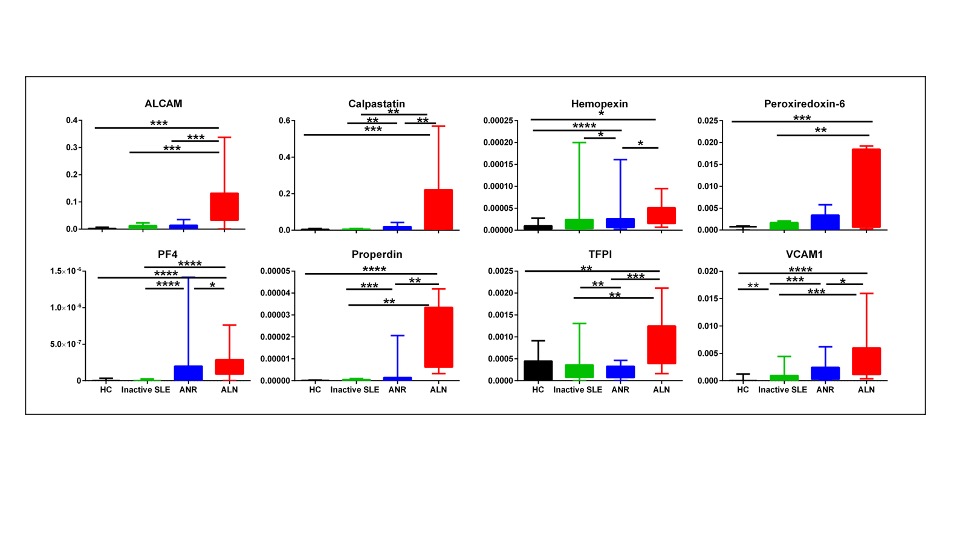 Fractional Excretion ratios of eight protein biomarkers in SLE patients and controls. Fractional excretion (FE) ratios of all 8 biomarker proteins were calculated by dividing the urine biomarker levels by the corresponding serum biomarker levels, after normalizing both against urine or serum creatinine, respectively. The Y axes show the values of the fractional excretion ratios of studied biomarkers as well as their SE (error bars), while the X axes display the 4 groups interrogated (25 healthy controls; 32 inactive SLE; 31 active non-renal disease; 33 active renal disease). * = P < 0.05, ** = P < 0.01, *** = P < 0.001, **** = P < 0.0001.
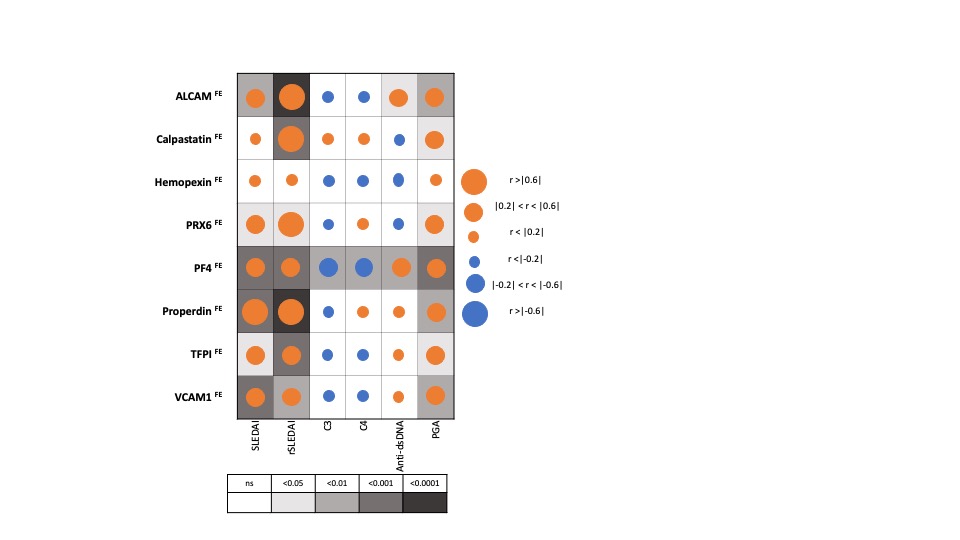 Correlation of Fractional Excretion (FE) ratios of eight protein biomarkers with conventional disease activity measures in SLE. The derived FE ratios of the eight interrogated biomarkers were examined for their correlation with SLEDAI, renal-SLEDAI, C3, C4, anti-dsDNA and Physician Global Assessment (PGA) values. Positive and negative correlations are denoted by orange and blue circles respectively, while statistical significance is denoted using grey-scale boxes. Overall, the urine biomarker fractional excretion ratios correlate best with renal-SLEDAI in LN.
 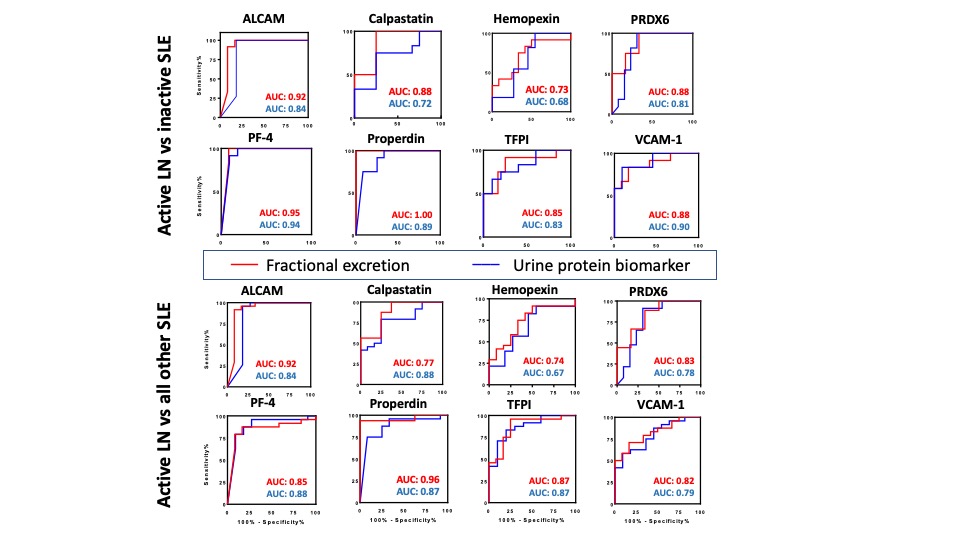 Comparing the diagnostic potential of FE ratios and their corresponding urine biomarkers in identifying active LN. Receiver Operating Characteristic (ROC) curves were generated for the 8 urine protein markers (blue line) and their corresponding FE ratios (red line) in differentiating active lupus nephritis from inactive SLE (top) and active lupus nephritis from all other SLE patients (active non-renal and inactive SLE) (bottom)