Poster Session B
Systemic lupus erythematosus (SLE)
Muhammad RA Shipa, MBBS, MRCP
University College London
LONDON, United Kingdom
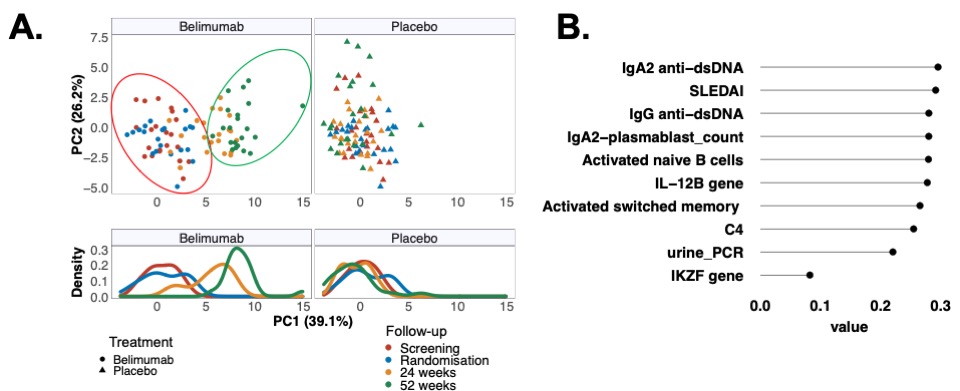 Figure 1A-B: Principal component analysis of longitudinal changes in immune profiles through to 52 weeks split into treatment groups for visualization purposes. (A) Each dot in the top panel represents a patient; and in the bottom panel population densities stratified by treatment and time-points are shown. First 2 principal components (PC) described 65.3% of the variance. (B) Contributions of top 10 variables loading weights in PC1.
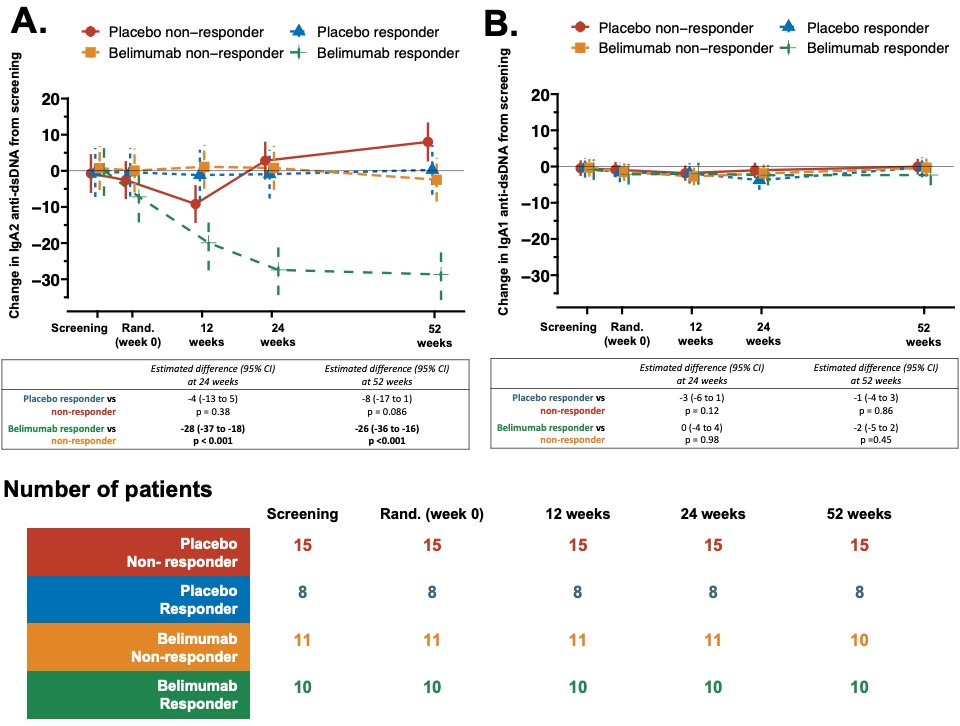 Figure 2A-B: Belimumab after rituximab decreased serum IgA2 anti-dsDNA antibody levels only in patients with SLE responding to this combination therapy. Longitudinal change in serum (A) IgA2 anti-dsDNA, and (B) IgA1 anti-dsDNA antibody levels stratified by treatment response in belimumab, and placebo treated group from baseline. A longitudinal linear mixed-effect model was fitted with random patient effect to account for clustering by patients and fixed effect of treatment group intercepting with trial times and adjusted for screening values, age, gender, concomitant mycophenolate (yes or no), and prednisolone dose at respective time points to calculate expected difference at 24 and 52 weeks. Estimated mean with 95% confidence intervals and number of patients at each time points (n) are shown; p values at weeks 24 and 52 are provided.