
.png)
Special Health Care Needs
Dental Age, Anomalies, and Malocclusion in Subjects with Autism


Stephanie Tan, DMD
Second Year Pediatric Dental Resident
Children's Hospital Colorado, Aurora, CO
Children's Hospital Colorado
Aurora, Colorado, United States

Chaitanya P. Puranik, B.D.S., M.S., M.Dent.Sci., PhD
Director of Predoctoral Education in Pediatric Dentistry
Children's Hospital Colorado and School of Dental Medicine, University of Colorado Anschutz Medical Campus
Children's Hospital Colorado and School of Dental Medicine, University of Colorado Anschutz Medical Campus
Aurora, Colorado, United States
.jpg "Roopa P. Gandhi, BDS, MSD photo")
Roopa P. Gandhi, BDS, MSD
Residency Program Director
Children's Hospital Colorado
Aurora, Colorado, United States
Kaci Pickett, MS
University of Colorado - Denver
Stephanie Tan, DMD
Second Year Pediatric Dental Resident
Children's Hospital Colorado, Aurora, CO
Children's Hospital Colorado
Aurora, Colorado, United States
Chaitanya P. Puranik, B.D.S., M.S., M.Dent.Sci., PhD
Director of Predoctoral Education in Pediatric Dentistry
Children's Hospital Colorado and School of Dental Medicine, University of Colorado Anschutz Medical Campus
Children's Hospital Colorado and School of Dental Medicine, University of Colorado Anschutz Medical Campus
Aurora, Colorado, United States
Roopa P. Gandhi, BDS, MSD
Residency Program Director
Children's Hospital Colorado
Aurora, Colorado, United States
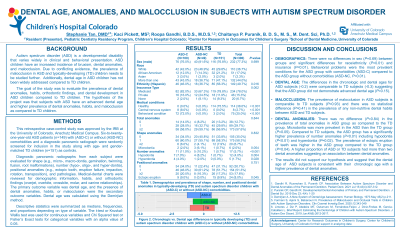
Purpose: The purpose of this study was to comparatively evaluate the association between dental age, anomalies, and malocclusion of the permanent dentition in subjects with autism spectrum disorder (ASD) as compared to typically developing (TD) children.
Methods: The electronic medical-dental records and panoramic radiographs of 6 to12-year-old randomly selected TD or ASD subjects were assessed retrospectively. One hundred age- and gender-matched pairs of TD and ASD were reviewed. The counts of shape, number, and positional dental anomalies were recorded along with orthodontic and medical findings. Dental age assessment was performed based on Demirjian’s method using panoramic radiographs. TD and ASD groups were compared using t-test or Kruskal-Wallis test for continuous variables dependent on distribution and Chi Squared test or Fisher’s Exact tests were used for categorical variables dependent on cell sizes.
Results: A higher proportion of study subjects in the study were enrolled in Medicaid. Approximately, 50% of the subjects included in the ASD group had severe Autism and 60% of the subjects in the ASD group were non-Hispanic. There was no difference in dental anomalies or orthodontic findings between ASD or TD groups. However, some orthodontic findings were not reported for the subjects in the ASD group possibly due to behavior. Although not significant, the TD group had slight dental delays compared to the ASD group.
Conclusions: TD and ASD subjects had comparable proportion of dental anomalies while there were no differences in orthodontic findings. Dental age of ASD and TD patients were consistent with their chronological ages.