
.png)
Sedation


Bryce W. Kinard, DMD
Resident PGY-2
NYU-Langone Hospital
NYU Langone Tucson Site
Tucson, Arizona, United States
Andrew Zale, DMD, MSD
NYU Langone
Tucson, Arizona, United States
Andrew Zale, DMD, MSD
NYU Langone
Tucson, Arizona, United States
Amanda Pinder, DDS
Program Director
NYU-Langone Hospital
Tucson, Arizona, United States
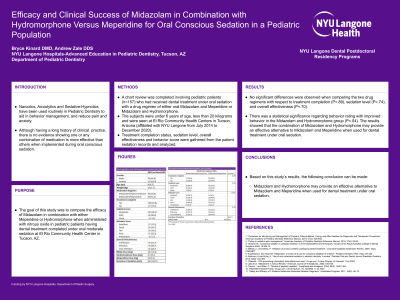
Purpose: The goal of this study was to compare the efficacy of Midazolam in combination with either Meperidine or Hydromorphone when administered in pediatric patients having dental treatment completed under oral moderate sedation.
Methods: A chart review was completed involving encounters (n=157) for pediatric patients who had received dental treatment under oral sedation with a drug regimen of either oral Midazolam and Meperidine or Midazolam and Hydromorphone. The subjects were under 6 years of age, less than 20 kilograms and were seen at El Rio Community Health Centers in Tucson, Arizona (affiliated with NYU Langone from July 2014 to December 2020). Treatment completion status, sedation level, overall effectiveness and behavior score were gathered from the patient sedation records and analyzed.
Results: No significant differences were observed when comparing the two drug regimens with respect to treatment completion (P=.89), sedation level (P=.74), and overall effectiveness (P=.70). However, there was a statistical significance regarding behavior rating with improved behavior in the Midazolam and Hydromorphone group (P=.04). The results showed that the combination of Midazolam and Hydromorphone may provide an effective alternative to Midazolam and Meperidine when used for dental treatment under oral sedation.