
.png)
Other


Ali Baghalian, DDS
Resident of Pediatric Dentistry
Rutgers School of Dental Medicine, Newark, NJ
Rutgers School of Dental Medicine
Newark, New Jersey, United States
Yasaman Abbasi, Dr
Rutgers School of Dental Medicine
Mahmoud Hormozi, Dr
Rutgers School of Dental Medicine
Richard Rosivack, DMD, MS
Chair, Department of Pediatric Dentistry
Rutgers School of Dental Medicine
Newark, New Jersey, United States
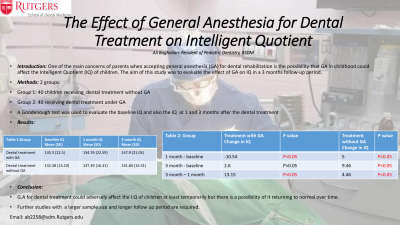
Purpose: The purpose of this study was to investigate the short-term effect of general anesthesia on the intelligence quotient (I.Q) of developing children, a concern for many parents.
Methods: In this cohort study, 40 children underwent restorative dental treatment using local anesthesia and 40 received treatment under general anesthesia (G.A). Intelligence quotients (I.Q) were determined using the Goodenough Draw-A-Person test before treatment, at 1 month follow up, and at 3 months follow up. A Mann-Whitney U Test was used for data analysis.
Results: In the G.A. cohort, there was a statistically significant decrease in I.Q from145.30 to 134.76(P < .05) 1 month following treatment. However, there was a significant increase in I.Q from 134.76 to 147.90 at the 3-month follow-up in comparison to 1 month after G.A. There was no significant difference when comparing baseline I.Q to the 3 months post-G.A. I.Q.
Patients receiving dental treatment without G.A showed a significant increase in I.Q from baseline (132.38) at both the 1-month and 3-months follow-up visits. 137.39 and 141.84 respectively.
Conclusion: Considering the significant increase in I.Q after 3 months in children who underwent dental treatment using local anesthesia, but no significant increase for those children who received treatment under G.A., this study found that G.A for dental treatment could adversely affect I.Q in developing children, at least temporarily. Further studies with a larger sample size and longer evaluation period are warranted.