
.png)
Sedation


Anna Kramer, DMD
Pediatric Dentistry Resident
University of Iowa, Iowa City, IA
University of Iowa
North Liberty, Iowa, United States
Kecia S. Leary, DDS, MS
Clinical Professor
University of Iowa
Iowa City, Iowa, United States
Amy Lesch, D.D.S., M.S.
Assistant Professor
University of Iowa College of Dentistry
Iowa City, Iowa, United States
Carissa Comnick, MS
University of Iowa College of Dentistry
Marisa Kallem, BS
University of Iowa College of Dentistry
Amy Lesch, D.D.S., M.S.
Assistant Professor
University of Iowa College of Dentistry
Iowa City, Iowa, United States
Kecia S. Leary, DDS, MS
Clinical Professor
University of Iowa
Iowa City, Iowa, United States
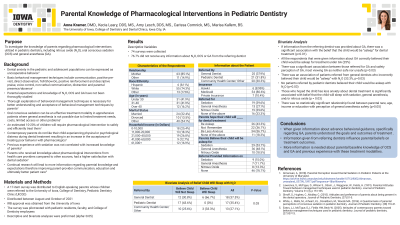
Objective: The purpose of this study was to evaluate parental knowledge and perception of pharmacological interventions used in pediatric dentistry, including nitrous oxide (N2O), oral conscious sedation (OCS) and general anesthesia (GA).
Methods: A 17-item survey was distributed to English-speaking parents whose children were referred to the University of Iowa, College of Dentistry, Pediatric Dentistry Clinic (UICOD). Descriptive and bivariate analyses were preformed (alpha=0.05).
Results: Seventy-four surveys were collected. Of those who participated, 37.9% were referred from a general dentist, 31.8% from a pediatric dentist and 30.3% from a community health center/ other referral source. Of the respondents, 76.7% did not receive any information about N2O, OCS or GA from the referring dentist. If information from the referring dentist was provided about GA, there was a significant association with the belief that the child would be “asleep” for dental treatment (P=.01). However, there was an association of patients referred from general dentists who incorrectly believed their child would be “asleep” with N2O (33.3%, P=.03) while none referred from a pediatric dentist believed their child would be “asleep” with N2O. There was no statistically significant relationship found between parental race, age, income or education with perception of general anesthesia safety (P>.05).
Conclusion: Information provided from the referring dentist influences parents’ knowledge and perception of pharmacological interventions.