
.png)
Other

Carol L. Wiese, DDS
Pediatric Dental Resident
University of Toledo
University of Toledo
Toledo, Ohio, United States
Niloufar Sadoughipour, MS candidate
University of Toledo
Homa Eskandari, PhD candidate
University of Toledo
George Choueiri, Dr, PhD
University of Toledo
Omid Amili, PhD
University of Toledo
Darya Dabiri, Dr., DMD, MS
Clinical Assistant Professor Surgery: Dentistry
University of Toledo
Toledo, Ohio, United States
Michael P. Nedley, DDS
Assistant Professor
University of Toledo
Toledo, Ohio, United States
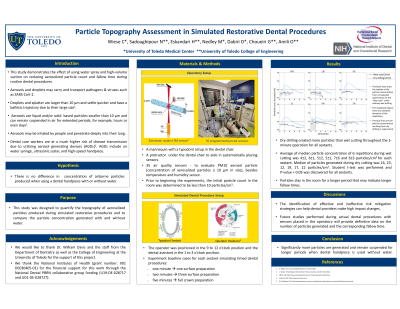
Purpose: To quantify the topography of particles produced during restorative dental procedures and compare the particle concentration generated with and without water.
Methods: 35 air quality sensors were systematically positioned in a dental operatory. A dentist and assistant simulated various timed restorative procedures on 6 sextants of a dental typodont. To establish a baseline particle count, the typodont was drilled for 2 minutes using an air turbine water cooled handpiece. The procedure was repeated without water to quantitate the number of particles generated. The median particle concentration from all 35 sensors was calculated from the beginning of the procedure until the particle concentration returned to less than 10 particles/cm3.
Results: Dry cutting created more particles than wet cutting throughout the 2-minute operation for all sextants. Average of median of particle concentration of 6 repetitions of wet cutting was 4±2, 6±1, 5±2, 5±1, 7±6 and 6±3 particles/cm3 for upper right, upper left, lower right, lower left, upper anterior and lower anterior sextants respectively. However, median of generated particles from dry cutting was 16, 23, 12, 19, 17, 22 particles/cm3. Z test was performed and P-value = 0 was discovered for all sextants. In addition, the results showed particles stay in the room for a longer period resulting in longer fallow times.
Conclusion: Significantly more particles are generated and remain suspended for longer periods when using a dental handpiece without water coolant.