
.png)
Restorative

.jpg "Miguel A. Simancas-Pallares, DDS, MSc photo")
Miguel A. Simancas-Pallares, DDS, MSc
Resident in Pediatric Dentistry
Division of Pediatric and Public Health, Adams School of Dentistry, University of North Carolina, Chapel Hill, NC
Division of Pediatric and Public Health, Adams School of Dentistry, University of North Carolina, Chapel Hill, NC
Chapel Hill, North Carolina, United States
hudson D. Spangler, BS
Adams School of Dentistry, University of North Carolina at Chapel Hill
Jeannie Ginnis, DDS
Adams School of Dentistry, University of North Carolina at Chapel Hill
William F. Vann, Jr, DMD, MPH, PhD
Adams School of Dentistry, University of North Carolina at Chapel Hill
Tim Wright, DDS, MS
Adams School of Dentistry, University of North Carolina at Chapel Hill
Apoena A. Ribeiro, DDS, MS, PhD
Adams School of Dentistry, University of North Carolina at Chapel Hill

Kimon Divaris, DDS, PhD
Professor
Division of Pediatric and Public Health, Adams School of Dentistry, University of North Carolina, Chapel Hill, NC
University of North Carolina-Chapel Hill
Chapel Hill, North Carolina, United States
Kimon Divaris, DDS, PhD
Professor
Division of Pediatric and Public Health, Adams School of Dentistry, University of North Carolina, Chapel Hill, NC
University of North Carolina-Chapel Hill
Chapel Hill, North Carolina, United States
.jpg "Jessica Y. Lee, DDS, MPH, PhD photo")
Jessica Y. Lee, DDS, MPH, PhD
Chair, Division of Pediatric and Public Health
University of North Carolina
Chapel Hill, North Carolina, United States
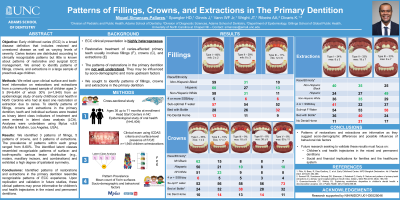
Objective: Early childhood caries (ECC) is a broad disease definition that includes restored and unrestored disease as well as varying levels of severity. Caries lesions are distributed according to clinically recognizable patterns but little is known about patterns of restorative and surgical ECC management. We aimed to identify patterns of fillings, crowns, and extractions in a large sample of preschool-age children.
Methods: We relied upon clinical surface and tooth-level information on restorations and extractions from a community-based sample of children ages 3-5 [N=6,404 of which 30% (n=1,940) from an epidemiologic study of early childhood oral health in North Carolina who had at least one restoration or extraction due to caries. To identify patterns of fillings, crowns and extractions in the primary dentition, teeth and individual surfaces were treated as binary latent class indicators of treatment and were entered in latent class analysis (LCA). Analyses were undertaken using Mplus v.8.5 (Muthén & Muthén, Los Angeles, USA).
Results: We identified 3 patterns of fillings, 5 patterns of crowns, and 3 patterns of extractions. The prevalence of patterns within each group ranged from 8-60%. The identified latent classes resembled recognizable patterns of surface- and tooth-specific carious lesion distribution (e.g., molars, maxillary incisors, and combinations) and exhibited a high degree of ipsilateral symmetry.
Conclusions: Identified patterns of restorations and extractions in the primary dentition resemble recognizable patterns of ECC experience. Upon replication and validation in future studies, these clinical patterns may prove informative for children’s oral health trajectories in the mixed and permanent dentitions.