
.png)
Pulp Therapy

Mojdeh Salehi, DMD
Pediatric Dental Resident- PGY2
Montefiore Medical Center
Montefiore Medical Center
Bayside, New York, United States
Nuntiya Kakanantadilok, DMD
Director of Residency Education, Division of Pediatric Dentistry
Montefiore Medical Center
Bronx, New York, United States
Cyelee Kulkarni, DMD
Montefiore Medical Center
Bronx, New York, United States
Alice Lee, DDS
Associate Director/Assistant Professor
Montefiore Medical Center
Bronx, New York, United States
Success Rate of Ferric Sulfate Pulpotomy Under Different Levels of Sedation. Salehi M, Kulkarni C, Kakanantadilok N (Montefiore Health System/Albert Einstein College of Medicine, Bronx, NY)
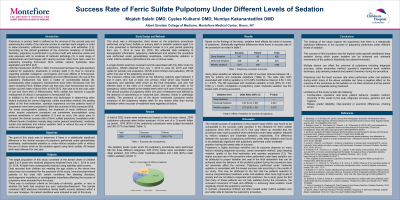
Purpose: The purpose of this study was to determine if there is a statistically significant difference in the clinical success rate of Ferric Sulfate pulpotomy performed under different levels of sedation namely general/deep anesthesia, oral/moderate sedation or mild/no sedation (with or without the use of nitrous oxide as the sedative agent). All treated teeth were followed for one year (6 or 12 month recalls).
Methods: A retrospective chart review was done of 2309 pulpotomy procedures performed using Ferric Sulfate on primary teeth in pediatric patients aged 3 to 8 who presented to Montefiore Medical Center in a 4 year period spanning from July 1, 2014 to June 30, 2018. All treated teeth were restored using stainless steel crowns and were followed for one year. The clinical success of pulpotomy was defined by the absence of spontaneous or nocturnal pain, abscess, fistula or pathologic mobility.
Results: Statistically significant differences were found in the success of pulpotomy performed under different levels of sedation. When performed under deep sedation, pulpotomy had the highest sucess rate and the odds of success was reduced between 28-36% for mild/no sedation and moderate sedation respectively.
Conclusion: The overall success of pulpotomy in the current study was found to be comparable to the success rates reported in the literature for ferric sulfate pulpotomy. At the conclusion of the 12 month follow up, the procedure had the highest odds of success when performed under deep sedation/general anesthesia followed by mild/no sedation and was found to be the least successful when completed under moderate sedation .