
.png)
Other

Thomas H. Raddall, IV, DDS
Pediatric Dentistry Resident, PGY-2
Boston Children’s Hospital, Boston, MA
Boston Children's Hospital, Harvard School of Dental Medicine
Boston, Massachusetts, United States
Rosalyn M. Sulyano, DMD, MS
Boston Children's Hospital

Young S. Yi, DMD, FAAPD
Pediatric Dental Resident
Boston Children's Hospital
Boston Children's Hospital
Boston, Massachusetts, United States
Young S. Yi, DMD, FAAPD
Pediatric Dental Resident
Boston Children's Hospital
Boston Children's Hospital
Boston, Massachusetts, United States
Isabelle Chase, DDS, FRCD(C)
Program Director
Boston Children's Hospital, Boston, MA
Harvard School of Dental Medicine
Boston, Massachusetts, United States
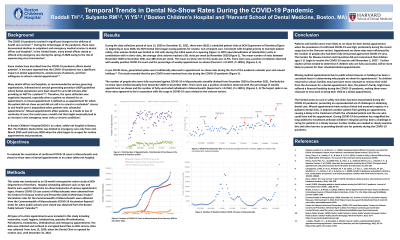
Temporal Trends in Dental No-Show Rates During the COVID-19 Pandemic, Raddall TH1,2, Sulyanto RM1,2, Yi YS1,2 (1Boston Children’s Hospital and 2Harvard School of Dental Medicine, Boston, MA)
Purpose: To evaluate the association of confirmed COVID-19 cases in Massachusetts and show/no-show rates of dental appointments in an urban safety-net hospital.
Methods: This 18-month retrospective cohort study at Boston Children’s Hospital (BCH) Department of Dentistry used hospital scheduling software to determine no-show frequencies of various appointment types and the aggregate COVID-19 cases in Massachusetts reported by Centers for Disease Control and Prevention (CDC) COVID Data Tracker. All types of in-clinic appointments were included.
Results: The mean no-show rate for 38,011 scheduled patient visits was 11.9%. There was a positive correlation with weekly positive COVID-19 count and the percentage of weekly appointment no-shows (Pearson’s r=0.3187; P</em>=.0035). Spikes in no show rates were observed during the weeks surrounding national holidays and the beginning and end of the academic school year. The largest spike appeared to be associated with the surge in COVID-19 cases related to the Omicron variant.
Conclusion: Patients and families were more likely to no-show for their dental appointment when the prevalence of confirmed COVID-19 was high, particularly during the recent surge due to the Omicron variant. The limited access to care in safety net clinics has been exacerbated during the COVID-19 pandemic, presenting an unprecedented set of challenges in obtaining dental care. Further studies are needed to assess these barriers to care during the COVID-19 pandemic.