
.png)
Restorative


Jennifer Vargas, DDS
Pediatric Dental Resident
BronxCare Health System
BronxCare Health System
New York, New York, United States
Soon Kwon, DMD
Program Director
BronxCare Health System, Bronx, NY
Bronx, New York, United States
Ingrid A. Dowrich, DDS
BronxCare Health System
Soon Kwon, DMD
Program Director
BronxCare Health System, Bronx, NY
Bronx, New York, United States
Soon Kwon, DMD
Program Director
BronxCare Health System, Bronx, NY
Bronx, New York, United States
Purpose: To compare the success rates of dental restorations completed under nitrous oxide inhalation and general anesthesia for pediatric patients with early childhood caries.
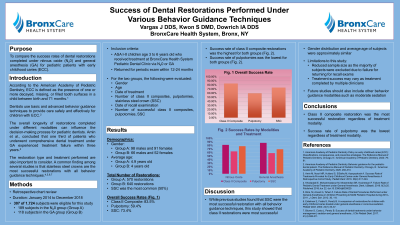
Methods: A retrospective chart review of pediatric patients who received treatment at BronxCare Health System Pediatric Dental Clinic under nitrous oxide inhalation or general anesthesia during a four-year period from January 2014 through December 2018 was completed. Only 307 of 1,724 charts were eligible as these subjects returned for their periodic oral examination within a 12 to 24 month period to evaluate placed restorations. For the two groups, the following was noted from the Dentrix Electronic Dental Health Record: gender, age, date of treatment, number of class 2 composites, number of pulpotomies, number of stainless steel crowns, date of recall examination, number of successful class 2 composites, number of successful pulpotomies, and number of successful stainless steel crowns.
Results: The sucess rate of class 2 composites was 81.6% under nitrous oxide, 87% under general anesthesia, and 83.5% overall. The success rate of pulpotomies was 63.2% under nitrous oxide, 58.4% under general anesthesia, and 59.4% overall. The success rate of stainless steel crowns was 77.9% under nitrous oxide, 69.4% under general anesthesia, and 73.4% overall.
Conclusions: Class II composite restoration was the most
successful restoration regardless of treatment
modality. Success rate of pulpotomy was the lowest
regardless of treatment modality.