
.png)
Other


Sofía Iribarren, DDS
Pediatric Dentistry and Dental Public Health Resident
University of Iowa, Iowa City, IA
University of Iowa
Coralville, Iowa, United States
John J. Warren, DDS, MS
University of Iowa
Amy Lesch, D.D.S., M.S.
Assistant Professor
University of Iowa College of Dentistry
Iowa City, Iowa, United States
Sean W. McLaren, DDS
Eastman Institute for Oral Health
Julie C. Reynolds, DDS, MS
Assistant Professor
University of Iowa
Iowa City, Iowa, United States
Kecia S. Leary, DDS, MS
Clinical Professor
University of Iowa
Iowa City, Iowa, United States
Objectives: Teledentistry is a care modality suggested to enhance access to dental care for vulnerable children, but few studies have evaluated the impact of teledentistry on access to dental care. This study examined the impact of new patient synchronous teledentistry visits for children referred to a university dental setting and assessed whether having a new patient teledentistry visit improves access to care compared to referred patients seen only via in-person visits.
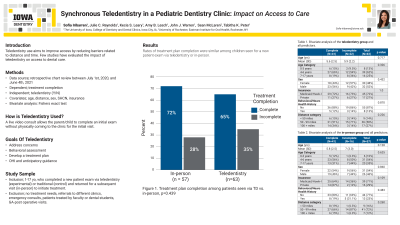
Methods: A retrospective chart review was conducted for new patients in the Department of Pediatric Dentistry at The University of Iowa between July 1st, 2020, and May 31st, 2021. Treatment completion, appointment completion, and a change in behavior guidance modality (i.e., dental clinic-based without moderate sedation, or hospital-based general anesthesia; dental clinic-based nitrous oxide/oxygen inhalation; dental clinic-based moderate sedation; hospital-based general anesthesia) were compared between patients seen on-site and those seen via teledentistry. Multivariable logistic regression models were used to compare treatment completion between the on-site and teledentistry cohorts after adjusting for potential confounders, including patients’ age, distance traveled, insurance status, and treatment complexity.
Results: Out of approximately 1,288 total patients who were referred to the pediatric dentistry clinic during the study time frame, approximately 81 had a new patient teledentistry visit. Preliminary results suggest that teledentistry is a viable means of facilitating new patient visits for pediatric patients. Further analyses will fully compare outcomes of those with teledentistry visits vs. traditional visits.
Conclusion: The findings provide insight on the impact of teledentistry on access to dental care for vulnerable pediatric patients and effectively supplement in-person exams.