
.png)
Other
COVID-19 Pandemic Effects on Kentucky Medicaid Access to Dental Care

Ivan Huynh, DMD
PGY-2 Resident
University of Kentucky, Lexington, KY
Lexington, Kentucky, United States
Kelly Dingrando, DMD
Attending Faculty
University of Kentucky
Lexington, Kentucky, United States
Kelly Dingrando, DMD
Attending Faculty
University of Kentucky
Lexington, Kentucky, United States
.jpg "Cristina Perez, DDS MS photo")
Cristina Perez, DDS MS
Program Director
University of Kentucky
University of Kentucky
Lexington, Kentucky, United States
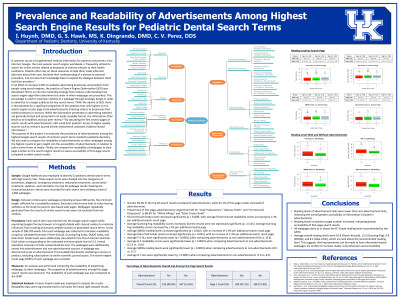
Purpose: The purpose was to evaluate the prevalence of advertisements among the highest Google search results of common search terms related to pediatric dentistry, to compare readability of advertisements to non-advertisements, and to observe readability as a function of Google search result page to determine accessibility of search engine results to the general public.
Methods: Google AdWords was employed to identify 53 pediatric dental search terms with high search rates divided into seven broad categories. Readability of the top 20 webpage results for each search term were evaluated using four validated readability formulae: Dale-Chall, Gunning-Fog, SMOG Index, and Flesch-Kincaid. Each webpage was evaluated for advertisements. Results were analyzed using a linear mixed model (p-values ≤ 0.042), readability values were log-transformed to account for heavy right skew. (P < .05).
Results: Average readability decreased across all four formulae per additional search result page. Average readability of advertisement links was higher compared to non-advertisement links for all four formulae.
Conclusions: Information contained in advertisements are generally more accessible compared to other forms of online media. Readability decreases as the search engine result page increases, indicating greatest accessibility of results found on the first page of Google results. Average overall readability scores across all formulae exceeded the 6th grade reading level recommended by the AAP, indicating a need for online information sources that are easier for patients and parents to understand.