
.png)
Special Health Care Needs


Marina Meshreky, DMD
Pediatric Dental Resident
Children’s National Medical Center, Washington, D.C.
George Washington University
Columbia, Maryland, United States
Tyler Mesa, DDS
Children's National Hospital
Kathleen Atmore, PsyD
Children's National Hospital
.jpg "Aunpama Tate, Pediatric Dentist photo")
Aunpama Tate, Pediatric Dentist
Director of Oral Health Advocacy & Research
Children's National Hospital
The George Washington Univeristy School of Medicine
Washington, District of Columbia, United States
Aunpama Tate, Pediatric Dentist
Director of Oral Health Advocacy & Research
Children's National Hospital
The George Washington Univeristy School of Medicine
Washington, District of Columbia, United States
Mitali Patel, DDS
Program Director
Children's National Hospital
Washington, District of Columbia, United States
Purpose: Autism spectrum disorder (ASD) is a general term for a group of complex disorders of brain development. There are several barriers to dental treatment that exist for individuals with ASD such as social communication deficits, intellectual disability, and increased sensory sensitivity. These barriers often result in undesirable behaviors during dental appointments which can lead to hesitation by certain providers to treat individuals with ASD. Several techniques have proven to improve behavior of individuals with ASD in a dental setting.This quality improvement (QI) project aims to implement a protocol within The Department of Dentistry at Children’s National Hospital (CNH) to improve overall experience for patients diagnosed with ASD during dental visits.
Methods: Resources such as a pre-appointment questionnaire, picture exchange communication system, and a social story were developed and implemented by the CNH Department of Dentistry. These resources were made accessible, both in person and virtually, to patients with ASD and their caregivers prior to their dental appointments. Forty-two caregivers were provided a post-survey to assess the effectiveness of the resources.
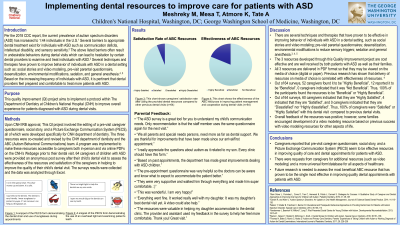
Results: Survey analysis demonstrated that 100% of the guardians were “Satisfied” or “Highly Satisfied” with the resources and 100% of the guardians reported the resources to be “Beneficial” or “Highly Beneficial”.
Conclusion: The resources implemented through this QI project are cost effective and appear to be well received by both patients with ASD as well as their families. Further research is necessary to determine the most efficacious resource for families to use prior to their child’s appointment.