
.png)
Special Health Care Needs


Adam Lowenstein, DMD
PGY-2
Tufts University School of Dental Medicine
Tufts University School of Dental Medicine
Wellesley, Massachusetts, United States
Gerald Swee, BS, MS, DMD
Tufts University
Matthew Finkelman, PhD
Tufts University School of Dental Medicine
.jpg "Dave A. Tesini, DMD MS photo")
Dave A. Tesini, DMD MS
Associate Clinical Professor
Tufts University School of Dental Medicine
Natick , Massachusetts, United States
Cheen Y. Loo, BDS, PhD, MPH, DMD
Professor, Chair and Program Director
Tufts University School of Dental Medicine
Boston, Massachusetts, United States
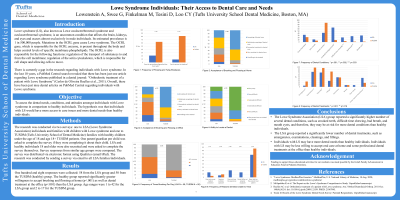
Purpose: The purpose of this study was to assess the dental needs, conditions, and attitudes amongst individuals with Lowe syndrome (LS) in comparison to healthy individuals. The hypothesis was that individuals with LS would have more access to care issues and more dental needs than healthy individuals.
Methods: A 21-question survey was developed with questions about access to dental care and the individuals’ dental attitudes and needs, including caries, inflammation, sore mouth, misaligned teeth, difficult time chewing, bad breath, and oral cysts. After face and content validation, the Lowe Syndrome Association (LSA) parent/caregiver received the survey via email and responded regarding the oldest individual in the household with LS. At the Tufts University School of Dental Medicine (TUSDM) Department of Pediatric Dentistry, the parent/caregiver of healthy individuals completed the survey via iPad.
Results: One hundred and eight responses were collected: 58 from the LSA group and 50 from the TUSDM group. The LSA group reported a significantly higher percentage of oral cysts (p < .001), misaligned teeth (p < .001), and bad breath (p= .002) than the healthy group. The healthy group reported significantly greater willingness to accept brushing and flossing at home (p < .001) as well as dental treatment at the office (p < .001) than the LSA group.
Conclusion: Individuals with LS may have more dental needs than healthy individuals. Individuals with LS may be less willing to accept oral care at home and some professional dental treatments at the office.