
.png)
Other


Mark Van Duker, DDS
Resident
Children’s National Medical Center, Washington, D.C.
Children's National Hospital
Washington, District of Columbia, United States
Erica Caffrey, DDS
Children's National Medical Center
Washington, District of Columbia, United States
Tamara Gayle, M.D., M.E.d.
Children's National Medical Center
Erica Caffrey, DDS
Children's National Medical Center
Washington, District of Columbia, United States
Mitali Patel, DDS
Program Director
Children's National Hospital
Washington, District of Columbia, United States
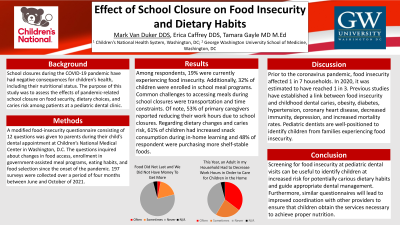
Purpose: School closures during the COVID-19 pandemic have had negative consequences for children’s health, including their nutritional status. The purpose of this study was to assess the effects of pandemic-related school closure on food security and dietary choices among patients at a pediatric dental clinic.
Methods: A modified food-insecurity questionnaire consisting of 12 questions was given to parents during their child’s dental appointment at Children’s National Hospital in Washington, D.C. The questions inquired about changes in food access, enrollment in government-assisted meal programs, eating habits, and food selection since the onset of the pandemic. 197 surveys were collected over a period of four months between June and October of 2021.
Results: Among respondents, 19% were currently experiencing food insecurity. Additionally, 32% of children were enrolled in school meal programs. Common challenges to accessing meals during school closures were transportation and time constraints. Of note, 53% of primary caregivers reported reducing their work hours due to school closures. Regarding dietary changes and caries risk, 61% of children had increased snack consumption during in-home learning and 48% of respondents were purchasing more shelf-stable foods.
Conclusion: School closures can have negative effects on food security and dietary choices among children. Screening for food insecurity at pediatric dental visits can be useful to identify children at increased risk for potentially carious dietary habits and guide appropriate dental management. Furthermore, similar questionnaires will lead to improved coordination with other providers to ensure that children obtain the services necessary to achieve proper nutrition.