
.png)
Preventive

Jenay Davis, DMD
Resident
Montefiore Medical Center
Montefiore Medical Center
Columbia, Maryland, United States
Mary Sayegh, DMD
Montefiore Medical Center
Bronx, New York, United States
Alice Lee, DDS
Associate Director/Assistant Professor
Montefiore Medical Center
Bronx, New York, United States
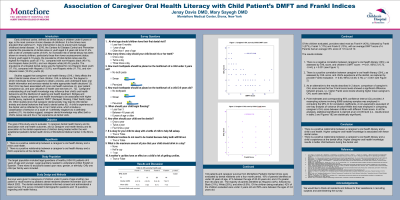
Title: Association of Caregiver Oral Health Literacy with Child Patients’ DMFT and Frankl Indices
Authors: Davis J* and Sayegh M
Purpose: The primary objective of this study is to evaluate if there is a correlation between a caregiver’s oral health literacy (OHL) and the child’s DMFT index. The secondary objective of this study is to assess if there is a correlation between caregiver OHL and their child’s experience at the dentist, captured by provider Frankl evaluation.
Methods: Surveys will be given to parents of healthy children (ASA I/II), 6 years of age and under, that present for new patient or recall exams at Montefiore Medical Center Pediatric Dental Clinics. Each parent will answer multiple choice questions regarding socio-demographic information and dental literacy. Completed surveys will be returned to the provider in a sealed envelope. Each provider will place the patient’s DMFT and Frankl scores on the outside of the envelope for analysis.
Results: 102 patients and caregiver surveys from Montefiore Pediatric Dental Clinics were evaluated by dental residents over a four month period. 18% of parents identified as under 20 years of age, 41% between the age of 20-30 years old, and 41% greater than 30 years old. The majority of parents identified as Hispanic (42%), followed by Black (31%), White (20%), and other (6.9%). Of the children being evaluated, 42% of the children evaluated were under 3 years old and 58% were between the ages of 3-6 years old. Of the children evaluated, providers rated most as Frankl 4 (43%), followed by Frankl 3 (27%), Frankl 1 (17%) and Frankl 2 (13%), with an average DMFT score of 4. Parents had an average OHL score of 5.5 out of 10.
Discussion: The results indicate:
1. There is a negative correlation between caregiver’s oral health literacy (OHL), as assessed by OHL score, and children’s DMFT score: r=-0.61, 95%CI (-0.73, -0.44); p < 0.001.
2. There is a positive correlation between caregiver’s oral health literacy (OHL), as assessed by OHL score, and child’s experience at the dentist, as captured by provider Frankl evaluation: r= 0.63, 95%CI (0.46, 0.75); p < 0.001.
Conclusion: 1. There is a positive relationship between a caregivers oral health literacy and a child’s oral health. Higher caregiver oral health knowledge is associated with fewer dental caries. 2. There is a positive relationship between a caregivers oral health literacy and a child’s experience at the dental office. Higher caregiver oral health knowledge results in better child behavior during the dental visit.