
.png)
Growth & Development


Erin Bibber, DMD
Resident
The Ohio State University/ Nationwide Children's Hospital
The Ohio State University
Columbus, Ohio, United States
Kim Hammersmith, DDS, MPH, MS
Program Director
The Ohio State University
Columbus, Ohio, United States
Paul S. Casamassimo, DDS, MS
Professor Emeritus
The Ohio State University/Nationwide Children's Hospital, Columbus, OH
The Ohio State University
Columbus, Ohio, United States
Janice A. Townsend, DDS, MS
The Ohio State University, Nationwide Children's Hospital
Jin Peng, MD, MS, PhD
Nationwide Children's Hospital
Ashok Kumar, DDS, MS
Nationwide Children's Hospital

Daniel Claman, DDS
Associate Program Director
The Ohio State University/Nationwide Children's Hospital
The Ohio State University/Nationwide Children's Hospital
Columbus, Ohio, United States
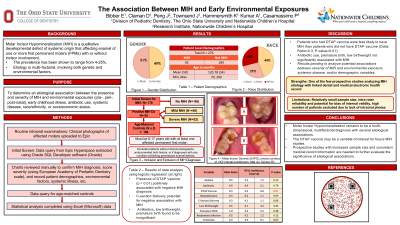
The Association Between MIH and Early Environmental Exposures
Bibber E, Claman D, Peng J, Casamassimo P, Townsend J, Hammersmith K, Kumar, A
Nationwide Children’s Hospital/The Ohio State University, Columbus, OH
Purpose: To determine associations between clinically-diagnosed Molar Incisor Hypomineralization (MIH) and environmental and socioeconomic variables including prenatal, perinatal or post-natal exposures, early childhood illness, antibiotic use, systemic disease, race/ethnicity, and socioeconomic status.
Methods: This hospital-based, nested case-control study involved children 6-17 years old identified as having MIH. Patients were recruited following a positive clinical diagnosis of MIH during an intraoral examination and documented by intraoral photographs. A single dental provider retrospectively confirmed the positive diagnosis of MIH via clinical photographs and rated severity of MIH using the European Academy of Pediatric Dentistry (EAPD) scale. Potential environmental and social factors that have been associated with MIH were identified from the electronic health record. Age-matched controls without a MIH diagnosis were identified and recruited for inclusion in the study. Eligibility criteria included continuous medical records including perinatal evaluation. Patients with amelogenesis imperfecta (AI), dentinogenesis imperfecta (DI), or any other condition exhibiting generalized enamel defects were excluded from the study.
Results: Pending data review.
Conclusion: Pending data review.