
.png)
Pulp Therapy

Nadareh Naseri, DDS
Resident
Bon Secours - St. Mary’s Hospital of Richmond,VA
Bon Secours St. Mary's Hospital
Richmond, Virginia, United States
Elizabeth Berry, DDS, MSD, MPH
Bon Secours St. Mary's Hospital
Richmond, Virginia, United States
Judy Reinhartz, PhD
Bon Secours St. Mary's Hospital
Dennis Reinhartz, PhD
Bon Secours St. Mary's Hospital
Elizabeth Berry, DDS, MSD, MPH
Bon Secours St. Mary's Hospital
Richmond, Virginia, United States
John H. Unkel, DDS, MD
Program Director
Bon Secours St. Mary's
Richmond, Virginia, United States
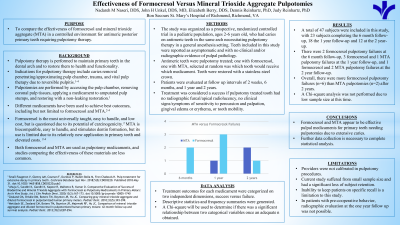
Purpose: The purpose was to determine the efficacy of formocresol and mineral trioxide aggregate (MTA) in vital pulpotomy therapy of antimeric posterior primary teeth.
Methods: Subjects aged 2-6 received formocresol and MTA pulpotomies in separate antimeric teeth in the same arch under general anesthesia. Patients were evaluated clinically and radiographically at intervals of 2 weeks, 6 months, and 1 year.
Results: A total of 86 primary molars were treated with either MTA or formocresol pulpotomies. Of the 86 teeth, 26 teeth met the study’s inclusion criteria of a completion to the one year follow up. The median age of patients receiving treatment was 4.4 years, and there were an equal number of males and females. There was one reported pulpotomy failure of the included teeth (n=26). The failure was a formocresol treated pulpotomy. Failure by tooth type was reported as maxillary primary first molar asymptomatic, but radiographic and clinical abscess which necessitated extraction.
Conclusions: The results showed that formocresol pulpotomies failed more than MTA pulpotomies after one year follow up; however, due the low number of actively treated primary teeth no statistically significant differences were observed. This study is ongoing to improve the quality of these findings.