
.png)
Syndromes/Craniofacial Anomalies

Evelyn Perez, DDS
Pediatric Dental Resident
University of Louisville, Louisville,KY
University of Louisville
Louisville, Kentucky, United States
Katerina Kavvadia, DDS
University of Athens
Katerina Kavvadia, DDS
University of Athens
Timothy B. Followell, DMD,MS
Graduate Program Director
University of Louisville
Louisville, Kentucky, United States
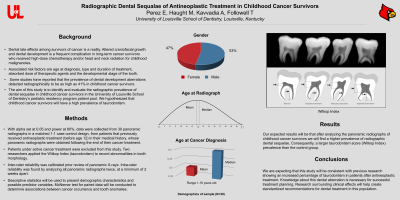
Background: The aim of this study was to identify and evaluate the radiographic prevalence of dental sequelae in childhood cancer survivors in the University of Louisville School of Dentistry’s pediatric residency program patient pool. We hypothesized that childhood cancer survivors will have a high prevalence of taurodontism.
Methods: In this matched 1:1 case control study, data were collected from 30 patients that previously received antineoplastic treatment before age 12, whose panoramic radiographs were obtained following the end of their cancer treatment. Patients under active cancer treatment were excluded from this study. Two researchers applied the Witkop Index (taurodontism) to record abnormalities in tooth morphology. Inter-rater reliability was calibrated prior review of panoramic radiographs. Intra-rater reliability was found by analyzing all panoramic radiographs twice, at a minimum of 2 weeks apart. Descriptive statistics were used to present demographic characteristics and possible predictor variables. McNemar test for paired data was conducted to determine associations between cancer occurrence and tooth anomalies.
Results: After analyzing the panoramic radiographs of childhood cancer survivors we found a higher prevalence of radiographic dental sequelae. Consequently, a larger taurodontism score (Witkop Index) prevalence than the control group was present.
Conclusion: This study was consistent with previous research showing an increased percentage of taurodontism in patients after antineoplastic treatment. Knowledge about this dental aberration is necessary for successful treatment planning. Research surrounding clinical effects will help create standardized recommendations for dental treatment in this population.