
.png)
Practice Management

.jpg "Spencer G. Warren, DDS photo")
Spencer G. Warren, DDS
Pediatric Dental Resident
Ohio State University, Columbus, OH
Ohio State University and Nationwide Children's Hospital
Columbus, Ohio, United States
Emre Sezgin, PhD
IT Project Scientist II
Nationwide Children's Hospital
Columbus, Ohio, United States
Daniel Claman, DDS
Associate Program Director
The Ohio State University/Nationwide Children's Hospital
The Ohio State University/Nationwide Children's Hospital
Columbus, Ohio, United States
Emre Sezgin, PhD
IT Project Scientist II
Nationwide Children's Hospital
Columbus, Ohio, United States
Daniel Claman, DDS
Associate Program Director
The Ohio State University/Nationwide Children's Hospital
The Ohio State University/Nationwide Children's Hospital
Columbus, Ohio, United States
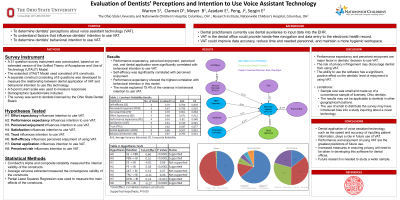
Purpose: The primary objective is to understand dentists’ perceptions and intention to use voice assistant software. A secondary objective is to understand if factors, such as age, location, and practice setting affects dentists’ perceptions and intention to use voice assistant software.
Methods: A survey was designed based on the Extended Unified Theory of Acceptance and Use of Technology (UTAUT), consisting of 31 questions. An additional set of 8 questions were developed in order to measure dentists’ intention to use voice assistant software in the dental office setting. A demographics section was also included in the survey. The survey was sent to a list of 7,544 Ohio-licensed dentists. The survey measures the factors influencing dentists’ perception of and intention to use voice assistant software, such as Apple Siri and Amazon Alexa. A 5-point Likert scale was utilized to collect responses from the survey. Descriptive statistics and partial least squares regression will be used to analyze the dentists’ intention to use voice assistant software. An independent t-test will also be utilized to measure the relationship between demographic factors and intention to use voice assistant software.
Results: Pending obtaining and analyzing responses from survey.
Conclusion: Pending obtaining and analyzing responses from survey. We believe the results will be informative for understanding the value and impact of voice assistants in dental practice in future implementations.