
.png)
Growth & Development
Structural Analysis of 3D Printed Pediatric Space Maintainers


Lydia Watson, DDS
Graduate Pediatric Dental Resident
University of Tennessee, Knoxville, TN
University of Tennessee
Memphis, Tennessee, United States
Brent Danley, DDS
University of Tennessee
Antheunis Versluis, MS
University of Tennessee
Memphis, Tennessee, United States
Daranee Tantbirojn, DDS, MS, PHD
University of Tennessee

Martha Wells, DMD, MS
Associate Professor and Program Director, Pediatric Dentistry
University of Tennessee Health Science Center
Memphis, Tennessee, United States
Antheunis Versluis, MS
University of Tennessee
Memphis, Tennessee, United States
Martha Wells, DMD, MS
Associate Professor and Program Director, Pediatric Dentistry
University of Tennessee Health Science Center
Memphis, Tennessee, United States
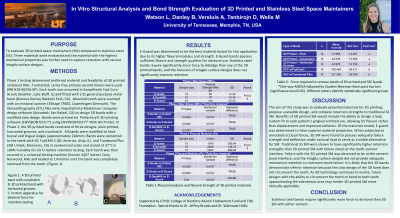
Purpose: To design and produce 3D printed space maintainers (SM). Three materials were evaluated and the material with highest mechanical properties was used to evaluate the effects of textured intaglio surfaces on retention in comparison to traditional stainless steel bands.
Methods: Fifteen beams were printed in E-Dent 400, E-Guide, and E-Guard to determine strength and elastic modulus in four-point bending. E-Guard was selected, printed into bands, and cemented to 3D printed testing blocks. The bands were vertically loaded to determine failure strength and displacement. The 3D bands were designed and printed with plain, crosshatched, and horizontally grooved intaglio surfaces and cemented to extracted primary teeth with Transcend plus and compared with traditional stainless steel bands. Retention will be determined by measuring the force to dislodge the bands from the teeth. All tests were conducted with a universal testing machine (Instron) at 0.5 mm/min loading rate, while load and deflection were recorded.
Results: Max Stress (MPa, mean±SD) of E-Guide, E-Dent, and E-Guard were (65±12), (90±13), (134±25), respectively. Elastic modulus (MPa, mean±SD) were (1540±399), (2489±144), and (2653±889), respectively. Failure loads (N) of 3D printed SMs were (124±22) and the deflection (mm) at fracture were (2±0). Results on retention tests with intaglio designs are pending.
Conclusions: E-Guard was best suited for fabrication of printed SM. 3D printed SM possess adequate flexural strength and deflection under occlusal load to serve as a viable alternative for space maintenance. Previous results demonstrate that 3D printed space maintainers had inferior retention compared to traditional stainless steel bands. Textured intaglio surface are expected to improve mechanical retention, thereby enhancing the practical application of 3D printed SM.