
.png)
Special Health Care Needs

Kevin Brunstein, DMD
Pediatric Dental Resident
Texas A&M College of Dentistry
Texas A&M School of Dentistry
Dallas, Texas, United States
Carolyn Kerins, DDS, PhD
Associate Professor and Graduate Program Director
Texas A & M University -—Baylor College of Dentistry, Dallas, TX
Dallas, Texas, United States
Steven Layton, DDS
Texas A&M College of Dentistry
Dallas, Texas, United States
Steven Layton, DDS
Texas A&M College of Dentistry
Dallas, Texas, United States
Carolyn Kerins, DDS, PhD
Associate Professor and Graduate Program Director
Texas A & M University -—Baylor College of Dentistry, Dallas, TX
Dallas, Texas, United States
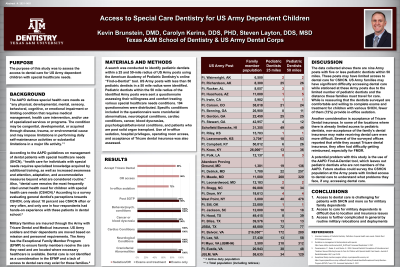
Purpose: The purpose was to assess if dental providers near U.S. Army posts accept Tricare dental insurance and are comfortable and willing to treat children with various special healthcare needs.
Methods: Pediatric dentists within a 50-mile radius of US Army posts were identified using the American Academy of Pediatric Dentistry’s online “Find-a-Dentist” tool. Offices identified were contacted and sent a questionnaire assessing their willingness and comfort treating various special healthcare needs conditions and types of insurances accepted.
Results: The data collected show nine Army posts with five or less pediatric dentists within 50 miles. These posts may have limited access to dental care for CSHCN. The dentists surveyed were comfortable and willing to complete exams and treatment for children with various SHCN, however fewer of them (72%) provide in-office sedation. Of the dentists surveyed, most (88%) reported acceptance of Tricare Dental Insurance.
Conclusions: Access to dental care is challenging for patients with SHCN and more so for military family dependents. Access to care for military dependents is difficult due to location and insurance issues. Access is further complicated in general by routine military relocations and deployments