
.png)
Sedation


Justin G. Milo, DDS
Pediatric Dental Resident
University of Maryland, Baltimore
University of Maryland, Baltimore
Baltimore, Maryland, United States
Ghaida Ureiga, BDS
University of Maryland
Manal Alzahrani, BDS
University of Maryland
Ozma Khushbakth, BDS
University of Maryland, Baltimore
Tomas Rivera, DA, RHS
University of Maryland, Baltimore
Glenn Canares, DDS
Research Mentor
University of Maryland, Baltimore
Baltimore, Maryland, United States

Vineet Dhar, BDS
Program Director
University of Maryland, Baltimore, MD
Baltimore, Maryland, United States
Assessing Child Temperament as a Predictor of Sedation Outcomes, Milo J, Canares G, Ureiga G, Alzahrani M, Khushbakth O, Rivera T (University of Maryland School of Dentistry, Baltimore, MD)
Purpose: Oral sedation is commonly used by pediatric dentists to complete dental treatment on children, however, the desired level of sedation and its effect on patient behavior is not always achieved. The purpose of this study is to investigate whether a child’s temperament, as measured by the Children’s Behavior Questionnaire Very Short Form (CBQ-VSF), has an association with sedation outcomes.
Methods: Children and their parent/guardian were enrolled to participate in the study from patients in the pediatric dental clinic scheduled to receive dental treatment with oral sedation using any combination of meperidine, hydroxyzine, and midazolam. Healthy children between the ages of 3 to 7 years that were American Society of Anesthesiology (ASA) classification I or II and spoke either English or Spanish were enrolled. The answers provided by the parent/guardian on the CBQ-VSF were used to assess child temperament. Level of sedation, behavior/responsiveness to treatment, and overall effectiveness of the oral sedation was determined using the American Academy of Pediatric Dentistry (AAPD) Sedation Record form. Success was defined as “good” or “excellent” behavior/responsiveness to treatment and an overall effectiveness rating of “effective” or “very effective.”
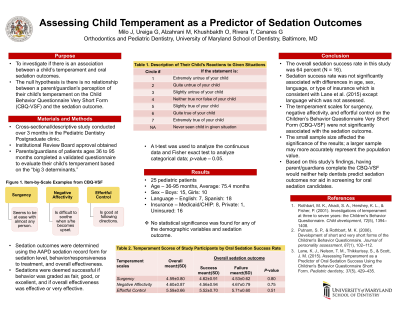
Results: There were 25 total patients included in this research study. Patients ranged in age from 36 to 95 months old with the mean age of 75.4 months (6.28 years). There were 15 boys included in the study compared to 10 girls. Of the 25 patients, 18 were native Spanish speakers and 7 spoke English. Regarding insurance, 8 patients had either Medicaid or were part of the CHIP program, only 1 patient had private insurance, and the remaining 16 patients were uninsured. No statistical significance was found for any of the demographic variables and sedation outcome. The temperament scales for surgency, negative affectivity, and effortful control were not significantly associated with sedation outcome.
Conclusions: The overall sedation success rate in this study was 64% (16/25 patients). Demographic variables and temperament scales were not significantly associated with sedation outcome, consistent with the Lane et al. 2015 study. The small sample size of patients affected the significance of the results; a larger sample would more accurately represent the population value. The study results indicate a child’s temperament based on parent/guardian completion of the CBQ-VSF is not associated with sedation outcomes and would not aid a dentist in screening for oral sedation candidates.