
.png)
Other


Vy Vy Vu, DMD, MPH
Pediatric Dental Resident
Boston Children’s Hospital, Boston, MA
Boston Children's Hospital, Harvard School of Dental Medicine
Boston, Massachusetts, United States
Keri Discepolo, DDS, MPH
Post Graduate Program Director of Pediatric Dentistry
Boston University Goldman School of Dental Medicine
Boston, Massachusetts, United States
Vy Vy Vu, DMD, MPH
Pediatric Dental Resident
Boston Children’s Hospital, Boston, MA
Boston Children's Hospital, Harvard School of Dental Medicine
Boston, Massachusetts, United States
Neeta Chandwani, DDS
Boston Children's Hospital, Boston, MA
Boston, Massachusetts, United States
Neeta Chandwani, DDS
Boston Children's Hospital, Boston, MA
Boston, Massachusetts, United States

Isabelle Chase, DDS, FRCD(C)
Program Director
Boston Children's Hospital, Boston, MA
Harvard School of Dental Medicine
Boston, Massachusetts, United States
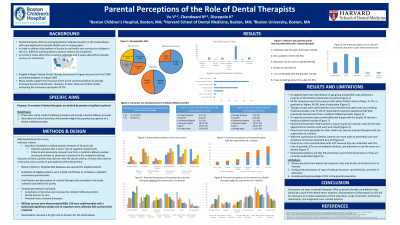
Purpose: To evaluate parental perceptions of the role of dental therapists (DTs). DTs are emerging dental midlevel providers in the United States. To date, there are limited studies evaluating the consumer perception of DTs.
Methods: Boston Children’s Hospital database, I2B2, was queried to identify healthy patients who were seen by a medical midlevel provider (nurse practitioner or physician’s assistant) in any department excluding Dentistry. Eligible families were invited via REDCap to complete a validated questionnaire regarding the acceptance of previous care by a medical midlevel provider, perceptions of barriers to dental care and the potential roles of DTs as dental midlevel providers.
Results: Analysis of 202 questionnaires indicate that 61.9% of parents agree that DTs should be part of the dental team, 32.37% are undecided, and 5.5% do not agree. With the supervision of a dentist, parents are more open to preventive care and treatment of primary dentition by a DT. Parents would likely accept seeing DTs if they were available sooner (58.5%) and easier to access than a dentist (53%). Though surveys were administered only to families that were seen by a medical midlevel provider, only 71.3% of respondents reported awareness that they previously received care from a medical midlevel provider.
Conclusion: Consumers are open to DTs as dental providers and believe they should be a part of the dental team; however, dissemination of information on DTs will be necessary to increase awareness of their education, scope of practice, community relationship, and integration into a dental practice.