
.png)
Other
The Efficacy of Video Counseling for Educating Parents


Jessica Berman, DDS
Pediatric Resident
University of Maryland, Baltimore, MD
University of Maryland, Baltimore
Baltimore, Maryland, United States
Ankita Jain, DDS
University of Maryland, Baltimore, MD
Nicholas Terrell, DDS
University of Maryland, Baltimore, MD
Hokyoung Jang, N/A
University of Maryland, Baltimore, MD
Mazin Nour Ahmed, N/A
University of Maryland, Baltimore, MD
Reem Almoshin, BDS
University of Maryland, Baltimore, MD
Norman Tinanoff, DDS
University of Maryland, Baltimore, MD
Baltimore, Maryland, United States
Norman Tinanoff, DDS
University of Maryland, Baltimore, MD
Baltimore, Maryland, United States

Vineet Dhar, BDS
Program Director
University of Maryland, Baltimore, MD
Baltimore, Maryland, United States
Materials and
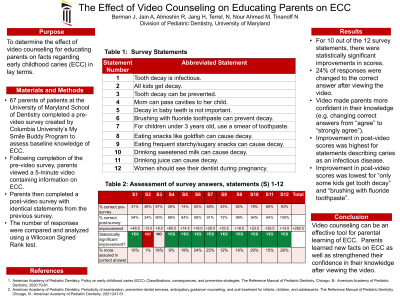
Purpose: The purpose of this study was to determine the effect of video counseling for educating parents on facts regarding early childhood caries (ECC) in lay terms.
Methods: Parents completed a pre-video survey assessing baseline knowledge on ECC. Following completion of the pre-video survey, parents viewed a 5-minute video in English created by Columbia University’s My Smile Buddy Program, containing information on ECC. The parents then completed a post-video survey with identical questions from the pre-video survey to assess learning. The pre-video and post-video survey answers were scored on the number of responses correct and compared using a Wilcoxon Signed Rank Test.
Results: For 10 out of 12 survey statements, there were statistically significant (α = 0.05) improvements in score among the participants. The improvement in score post-video was the highest for statements describing caries as infectious, "Tooth decay is an infectious disease" and "A mom can pass cavity-causing germs to her child." The improvement in score post-video was lowest for "Only some kids get tooth decay" and "Brushing twice a day with fluoride toothpaste can prevent tooth decay." The parents generally had correct understanding of prevention measures prior to viewing the video. Overall, 24% of the post-video survey responses were changed to the correct answer after viewing the video.
Conclusion: Video counseling can be an effective tool for parental learning of ECC.