
.png)
Other


Crystal Viss, DMD
Resident
University of Nevada, Las Vegas, NV
University of Nevada Las Vegas
Las Vegas, Nevada, United States
Gavin Banning, Dental Student
UNLV SDM
Sarah Swanbeck, Dental Student
UNLV SDM
Karl Kingsley, PhD, MPH
UNLV
Las Vegas, Nevada, United States
Karl Kingsley, PhD, MPH
UNLV
Las Vegas, Nevada, United States
William Buhler, DDS
University of Nevada, Las Vegas, NV
Las Vegas, Nevada, United States
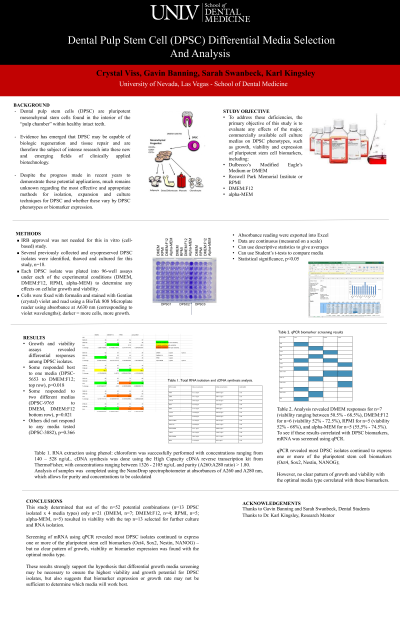
Objective: Dental pulp stem cells (DPSC) are the subjects of new and emerging fields of clinically applied biotechnology. However, much remains unknown regarding the most effective and appropriate methods for isolation, expansion and culture techniques for DPSC. To address these deficiencies, the primary objective of this study was to evaluate any effects of the major, commercially available cell culture media on DPSC phenotypes, such as growth, viability and biomarker expression.
Methods: Several previously collected and cryopreserved DPSC isolates were identified, thawed and cultured for this study, n=18. Each DPSC isolate was plated into 96-well assays under each of the experimental conditions (DMEM, DMEM:F12, RPMI, alpha-MEM) to determine any effects on cellular growth and viability. RNA was extracted from all DPSC isolates under the optimal growth conditions for screening using qPCR primers specific for DPSC biomarkers, such as Sox-2, Oct-4 and NANOG.
Results: Analysis revealed DMEM responses for n=7 (viability ranging between 50.5% - 68.5%), DMEM:F12 for n=6 (viability 52% - 72.5%), RPMI for n=5 (viability 52% - 68%), and alpha-MEM for n=5 (55,5% - 74.5%). Screening of mRNA using qPCR revealed most DPSC isolates continued to express one or more of the pluripotent stem cell biomarkers (Oct4, Sox2, Nestin, NANOG), but no clear pattern of growth with the optimal media type correlated with viability.
Conclusions: This study determined that out of the n=52 potential combinations (n=13 DPSC isolated x 4 media types) only n=23 (DMEM, n=7; DMEM:F12, n=6; RPMI, n=5; alpha-MEM, n=5) resulted in optimal viability. These results strongly support the hypothesis that differential growth media screening may be necessary to ensure the highest viability and growth potential for all DPSC isolates.