
.png)
Special Health Care Needs
Eliminating Barriers to Dental Care for CSHN through School-Based Programs

Jenna Permaul, DDS
Resident
New York University College of Dentistry
New York University College of Dentistry
South Ozone Park, New York, United States
Rose J. Amable, DDS, DABPD
New York University College of Dentistry
New York, New York, United States
Lauren Feldman, DMD
Postdoctoral Program Director
New York University
New York, New York, United States
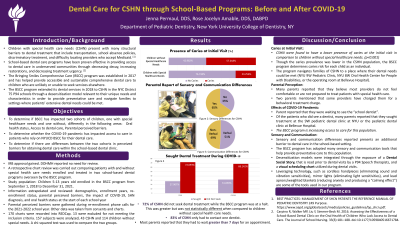
Purpose: This study evaluates access to dental care and oral health status for elementary school children with special healthcare needs(CSHN) treated in school-based dental programs. Variables assessed include communication barriers, sensory sensitivities, parental perceived barriers, as well as the impact of the COVID-19 pandemic.
Methods: A retrospective chart review was carried out to compare patients with and without special health care needs enrolled and treated in two school-based dental programs overseen by New York University College of Dentistry's Bringing Smiles Comprehensive Care (BSCC) program. The study population consisted of children 5-13 years old who enrolled in the BSCC program from September 1, 2018 to December 31, 2021. The following de-identified information was extrapolated and reviewed: demographics, enrollment years, re-enrollment status, parental perceived barriers, the impact of COVID-19, SHN diagnoses, and oral health status at the start of each school year.
Results: CSHN were found to have a lower presence of caries at the initial visit in comparison to children without special healthcare needs (p < 0.001). Seventy-two percent of CSHN did not seek dental treatment while the BSCC program was at a halt as result of the COVID-19 pandemic. This was greater but was not statistically different when compared to children without special health care needs. Eighty-three percent of CSHN only had to contact one dentist. Most parents reported that they had to wait greater than 7 days for an appointment. Sixty-five percent of CSHN have sensory differences and 49% are non-verbal.