
.png)
Restorative


Bryan W. Shin, MS
Pre-Doctoral Dental Student
University of Tennessee Health Science Center, College of Dentistry
University of Tennessee Health Science Center, College of Dentistry
Memphis, Tennessee, United States
Martin Donaldson, DDS, MS
Associate Professor
University of Tennessee Health Science Center
Memphis, Tennessee, United States
Brian R. Morrow, BS, MS
University of Tennessee Health Science Center
James C. Ragain, Jr, DDS, PhD
University of Tennessee Health Science Center
Franklin Garcia-Godoy, DDS, MS, PhD, PhD
University of Tennessee Health Science Center
Martin Donaldson, DDS, MS
Associate Professor
University of Tennessee Health Science Center
Memphis, Tennessee, United States
Hamid Yazdi, DDS
Program Director
University of Tennessee Health Science Center
Memphis, Tennessee, United States
Purpose: To evaluate the effect of toothbrushing and dentifrices on the surface roughness of 3 different brands of prefabricated pediatric zirconia crowns (ZRCs).
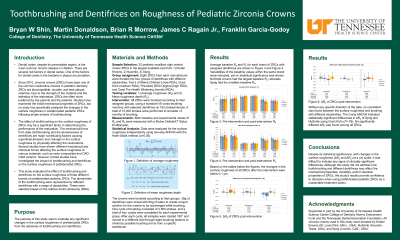
Methods: Thirty-two maxillary right central incisor prefabricated pediatric ZRCs were obtained from each of the following manufacturers: Kinder Krowns, NuSmile, and Sprig. ZRCs from each brand were equally assigned to 4 dentifrices with different abrasivities based on their Relative Dentin Abrasion (RDA) values: Tom’s of Maine Children’s toothpaste (Low), Crest Kid’s (Medium), Prevident 5000 Original (High), and Crest Pro Health (Harmful). ZRCs were brushed 10,000 strokes with a V-8 Cross Brushing Machine using the assigned dentifrices. Pre- and post-intervention data for the surface roughness of ZRCs, represented in Ra (average roughness) and Rz (mean roughness depth), were obtained using Bruker DektakXT Stylus Profilometer in μm. Data were analyzed independently using two-way ANOVA with the Holm-Sidak method (α=0.05).
Results: The ΔRa of Kinder Krowns and Sprig EZCrowns indicated statistically significant differences (P < .05). ΔRa of Sprig EZCrowns and NuSmile using Crest Kid's also had statistically significant differences (P < .05). There was no statistical significance in ΔRz.
Conclusions: Despite its statistical significance, with changes in the surface roughness (ΔRa and ΔRz) at a μm scale, it was difficult to indicate any signs of clinically significant differences. Although this study does not address how toothbrushing and different dentifrices may affect the mechanical properties, durability, and/or retention properties of ZRCs, the study's results provide confidence to clinicians when using prefabricated pediatric ZRCs as a sustainable treatment option.