
.png)
Patient Management
Video Modeling to Reduce Parental Dental Anxiety, Villanueva T, Pouyafar K, Best E, Feldman L New York University College of Dentistry, New York, NY

Trina Marie B. Villanueva, DDS
PGY2
New York University, New York, NY
New York University College of Dentistry
New York, New York, United States
Kimia Pouyafar, DDS
Pediatric Dental Resident
New York University, New York, NY
New York University College of Dentistry
New York, New York, United States
Lauren Feldman, DMD
Postdoctoral Program Director
New York University
New York, New York, United States
Elizabeth Best, MPH
Grants and Research Administrator
New York University
New York, New York, United States
Elizabeth Best, MPH
Grants and Research Administrator
New York University
New York, New York, United States
Lauren Feldman, DMD
Postdoctoral Program Director
New York University
New York, New York, United States
Purpose:
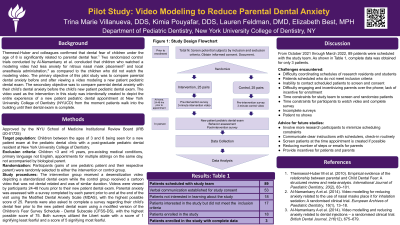
This study assesses whether viewing a video modeling a new patient pediatric dental exam reduces parental and child dental anxiety. In this double-blind randomized controlled trial, participants (pairs of one pediatric patient and their respective parent) are randomly selected to either the intervention or control group. The intervention group receives a desensitization video depicting a standardized dental exam via email while the control group receives a cartoon video that is not dental related and is of similar duration. Videos are viewed by participants 24-48 hours prior to their new patient dental exam. Parents complete a survey regarding their child’s dental fear prior to the new patient dental exam. Parental anxiety was assessed with a survey completed by each parent prior to and at the end of the visit. From October 2021 through March 2022, 89 patients were scheduled with the study team. Verbal communication for consent prior to the appointment was established with 53 of the scheduled patients, and of these, 18 patients were not interested in learning about the study, 17 patients were interested in the study but did not meet the inclusion criteria, and 18 patients were were emailed the informed consent form. Complete data was obtained for only 3 patients. Due to the low number of patients (3) for whom complete data was obtained, statistical analysis could not be completed. Nevertheless, the video created for this study may be used in future studies, as well as a general behavior management tool for the pediatric department at NYU College of Dentistry. Should the study be extended in the future, it may be improved by involving more research participants to minimize scheduling constraints, communicating clear instructions with front desk schedulers and checking in with them routinely throughout the study, screening patients at the time their appointment is created if possible, reducing the number of steps or emails sent to parents, and finally, providing incentives for the patients and parents.
Methods:
Results:
Conclusions: