
.png)
Oral Pathology

Steven Sau, DDS
Resident
Cohen Children’s Medical Center of Long Island Jewish Hospital, Queens, NY
Northwell Health
Glen Oaks, New York, United States
Kathleen Schultz, DMD
Attending Doctor
Cohen Children's Medical Center, Queens NY
Queens, New York, United States
Paul Crespi, DDS
Program Director
Cohen Children's Medical Center, Queens NY
Queens, New York, United States
Fibrous dysplasia (FD) is a benign disorder of bone in which areas of bone are replaced with a scar-like fibro-osseous tissue. This abnormal tissue can cause symptoms like bone pain, swelling, deformities, and fracture. FD can present as a single lesion affecting one bone (monostotic) or as multiple lesions affecting many bones (polyostotic). On rare occasion, polyostotic FD may occur as a component of McCune-Albright syndrome. In all forms of FD, the craniofacial bones are among the most commonly affected locations. Diagnosis of FD is usually made during childhood when symptoms become apparent. However, phenotypic presentation of the disease can vary and some cases of FD go undiagnosed until adulthood.
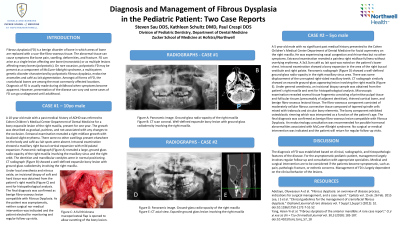
We describe two cases of fibrous dysplasia in pediatric patients presenting to the Cohen Children’s Medical Center Department of Dental Medicine. Both cases involve a male patient, ages 5 and 10 respectively, who present with non-painful, bony expansile lesions of the maxilla. Clinical, radiographic, and histopathological features were observed to confirm the diagnosis of FD in both cases. Description of the panoramic imaging and non-contrast CT scans included well defined expansile bony lesions with ground-glass density. Microscopic examination of the biopsied tissue revealed benign fibro-osseous lesional tissue consisting of moderately cellular fibrous connective tissue composed of tapered spindle cells admixed with trabecula and bony elements.
In both cases, the patients remained asymptomatic and were managed through monitoring and regular follow-up visits. Medical and surgical intervention are to be considered if the patients become symptomatic with problems such as pain, pathologic fracture, or esthetic concerns. Management of FD is largely dependent on the clinical behavior of the lesions.
Through routine clinical and radiographic examinations, dental practitioners are in a unique position for early detection and management of FD.