
.png)
Other

.jpg "Alexa C. Rosenau, DDS photo")
Alexa C. Rosenau, DDS
Pediatric Dentistry Resident
University of Iowa, Iowa City, IA
University of Iowa College of Dentistry
Tiffin, Iowa, United States
Wei Shi, MS
University of Iowa, Iowa City, IA
Macaira Leahy, DDS
University of Iowa, Iowa City, IA
Steven Fletcher, DDS, FACS
University of Iowa, Iowa City, IA
Fabrico Teixeira, DDS, MS, PhD
University of Iowa, Iowa City, IA
Steven Marshall, DDS, MS
University of Iowa, Iowa City, IA
Tad Mabry, DDS, MS
Clinical Professor
University of Iowa, Iowa City, IA
Iowa City, Iowa, United States
Kecia S. Leary, DDS, MS
Clinical Professor
University of Iowa
Iowa City, Iowa, United States
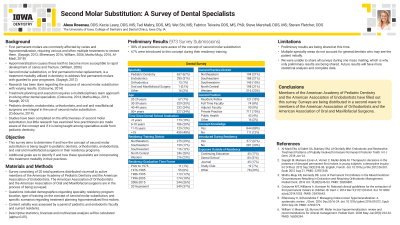
Purpose: Second molar substitution, also known as first permanent molar replacement, is a treatment modality proposed for problematic and non-restorable first permanent molars in children. The most common reasons first permanent molars require extraction are caries and hypomineralization. Although pediatric dentists are often the first dental professionals to discover these problematic teeth, treatment planning and execution requires a multidisciplinary team approach involving other dental specialists. In addition to pediatric dentists, endodontists, orthodontists, and oral maxillofacial surgeons all play a role in the process of second molar substitution. The main goal of this study is to determine if the concept of second molar substitution is being taught to specialists during their residency programs. Additional goals are to identify if and how these specialists are incorporating this treatment modality in their practices.
Methods: A survey was designed consisting of 20 total questions including: demographics regarding specialty and location of residency program, education and type of training on the concept of second molar substitution, and specific scenarios regarding treatment planning hypomineralized first molars. Content validity was assessed by a panel of pediatric and endodontic faculty and current residents. The survey will be distributed via email to active members of the American Academy of Pediatric Dentistry, the American Association of Endodontists, the American Association of Orthodontics, and the American Association of Oral and Maxillofacial surgeons. Descriptive statistics, bivariate and multivariate analysis will be calculated (alpha=0.05).
Preliminary
Results: 973 survey submissions, 88% of practitioners were aware of the concept of second molar substitution, 67% were introduced to this concept during their residency training.
Conclusion: Members of the American Academy of Pediatric Dentistry and the American Association of Endodontists have filled out this survey. Surveys are being distributed in a second wave to members of the American Association of Orthodontists and the American Association of Oral and Maxillofacial Surgeons.