
.png)
Other
Fire Evacuation Plan for Outpatient Dental Sedation Clinic, Lowe KL, Heard C, (University at Buffalo School of Dental Medicine, Buffalo NY)

Keturah L. Lowe, DDS
Pediatric Dental Resident
Advanced Education in Pediatric Dentistry, University at Buffalo School of Dental Medicine
University at Buffalo School of Dental Medicine/ John R. Oishei Children's Hospital
Buffalo, New York, United States

Christopher Heard, MD
Attending Anesthesiologist
University at Buffalo
Buffalo, New York, United States
Christopher Heard, MD
Attending Anesthesiologist
University at Buffalo
Buffalo, New York, United States
Carrie Wanamaker, DDS, DDS
Program Director, Advanced Education in Pediatric Dentistry
University at Buffalo
Buffalo, New York, United States
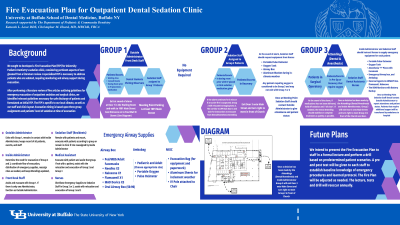
Purpose: This research developed a Fire Evacuation Plan (FEP) for University Pediatric Dental’s sedation clinic, considering pertinent aspects of care gleaned from a literature review. A specialized FEP is necessary to address patients who are sedated, requiring monitoring and airway support during evacuation.
Methods: After performing a literature review of five articles outlining guidelines for emergency evacuation of outpatient sedation and surgical clinics, we identified pertinent guidelines necessary for safe discharge of patients and formulated an initial FEP.
Results: The FEP is specific to our local climate, as well as our staff and clinic layout. Evacuation timing is based upon three group assignments and patients’ level of sedation at time of evacuation. Group 1, front office staff and patients/family in the pre-procedure evaluation process, will be fully evacuated when the fire alarm sounds. Group 2, staff and patients who have an intravenous line placed or are recovering from sedation, will be moved closer to an exit for evacuation during a prolonged fire alarm. For Group 3, patients who are undergoing procedures, in recovery, or require oxygen, procedures will be stabilized. Arrangements for airway and monitoring equipment during evacuation were also formulated.
Conclusion: