
.png)
Pulp Therapy


Jackie Fetner, DMD
Pediatric Dental Resident
University of Florida —Gainesville and Naples, Naples, FL
University of Florida, Gainesville, FL
JACKSONVILLE, Florida, United States
Marcio Guelmann, DDS
Program Chair
University of Florida —Gainesville and Naples, Naples, FL
Gainesville, Florida, United States
Abimbola O. Adewumi, DDS
Program Director
Florida
Gainesville, Florida, United States
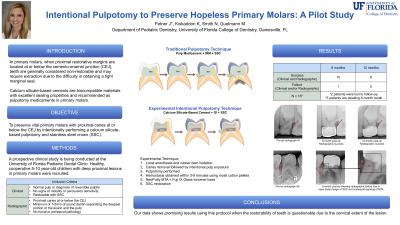
Purpose: To preserve vital primary molars with questionable restorability by intentionally performing a pulpotomy and stainless-steel crown (SSC), considering that the best space maintainer is the tooth itself.
Methods: Healthy, cooperative 5 to 10-year-old patients with deep proximal lesions at or below the cemento-enamel junction were recruited. Clinically, the pulpal diagnosis was healthy or reversible pulpitis, with no signs or symptoms of pulp degeneration. Radiographically, there was no evidence of furcal, periapical or periodontal pathology and at least 1-2mm of sound dentin separating the deepest portion of the lesion and the pulp. Following caries removal, the pulp was intentionally exposed and pulpotomy performed. Upon achieving hemostasis, a bioceramic cement (NeoPUTTY MTA) was used as pulp medicament followed by a glass ionomer chamber restoration (Fuji IX) and SSC coverage. Clinical and radiographic follow up was performed at 6 and 12 months. Clinical success was defined as lack of symptoms, swelling, or fistula; radiographic success was defined as lack of furcation or periapical pathology, or internal or external resorption.
Results: Currently, 16 teeth (14 patients) have been treated. Eleven teeth have been evaluated at the 6-month recall. Of these, 10 showed clinical and radiographic success and 1 had radiographic failure. Three teeth have been evaluated and shown clinical and radiographic success at the 12-month recall. Patient recruitment is still active.
Conclusions: Our limited data shows promising results using this treatment protocol in cases where the restorability of teeth is questionable due to the cervical extent of the lesion.