
.png)
Special Health Care Needs


Jian W. Lee, DDS
PGY-2
University of Pennsylvania School of Dental Medicine, Philadelphia, PA
University of Pennsylvania
Philadelphia, Pennsylvania, United States
Erin Cashman, 3rd Year Dental Student
Penn Dental Medicine
Maria F. Velasco, DMD, MSEd, MS
Director of the Pre-Doctoral Pediatric Program, Assistant Professor of Clinical Pediatric Dentistry
Penn Dental Medicine
Philadelphia, Pennsylvania, United States
Alina O'Brien, DDS
Assistant Program Director
University of Pennsylvania
Philadelphia, Pennsylvania, United States
Rick Guidotti, Portrait Photographer
Positive Exposure
Steven Perlman, DDS
BOSTON UNIVERSITY GOLDMAN SCHOOL OF DENTAL MEDICINE
Alina O'Brien, DDS
Assistant Program Director
University of Pennsylvania
Philadelphia, Pennsylvania, United States
Evlambia Hajishengallis, Professor, DDS, DMD, MSc, PhD
Division Chief of Pediatric Dentistry and Director of the Postdoctoral Pediatric Program at Penn Den
University of Pennsylvania
Philadelphia, Pennsylvania, United States
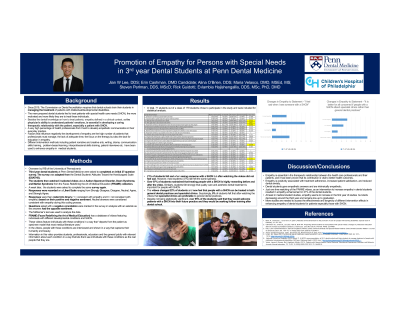
Purpose: The Commission on Dental Accreditation requires dental students be taught how to care for patients with Special Health Care Needs (SHCN). Dental graduates, however, report feeling ill-prepared to undertake the treatment of patients with SHCN. Inclan et al. found that all faculty from 10 dental schools received their experience in treating patients with SHCN during their residency training. In 2020, 52% of dental students participated in the ADA, National Match suggesting that over 40% of graduates do not seek out further training and rely on continuing education to supplement their learning. From those 40%, only the ones who have an interest in the SHCN population would seek out opportunities to further their own training in the care of these patients. Therefore, the purpose of the study was to investigate whether we can promote empathy for patients with SHCN in dental students and thus create an interest in seeking further training.
Methods: Seventy-one third-year students at the University of Pennsylvania School of Dental Medicine completed a survey to assess their baseline thoughts on interacting with and treating persons with SHCN. This survey was an adapted version of the Dental Students’ Attitudes Towards the Handicapped Scale. Three videos from the Faces Redefining the Art of Medical Education library were shown one week later. The students then repeated the survey.
Results: 21% of students felt sad when seeing someone with a SHCN but after watching the videos did not feel sad. However, most students (47%) still felt the same sadness. Over 97% of students maintained that treating people with a SHCN is highly rewarding before and after the video. Similarly, students felt strongly that quality care and aesthetic dental treatment is important for people with SHCN. The videos changed 22% of students and now feel that people with a SHCN can be treated in both general dental practices and specialist clinics. Surprisingly, 8%
of students felt that after watching the videos that specialist clinics are preferable to general dental practices. Despite not being statistically significant, over 95% of the students said that they would welcome patients with a SHCN into their future practice and they would be seeking further training after dental school.
Conclusions: Empathy is essential in the therapeutic relationship between the health care professionals and their patients, and it has been proven that its contribution is vital to better health outcomes. Empathy is positively associated with treatment adherence, increased patient satisfaction, and reduced dental anxiety. Dental students gave empathetic answers and are intrinsically empathetic. Just one time watching of the FRAME videos, as an intervention to increase empathy in dental students resulted in empathy enhancement in 21% of the dental students. At least in medical student studies, empathy seems to increase in the first year of studies but starts decreasing around the third year and remains low up to graduation. More studies are needed to access the effectiveness and longevity of different intervention effects in enhancing empathy of dental students for patients especially those with SHCN.