
.png)
Restorative
Removing prefabricated zirconia crowns from primary anterior teeth with Er,Cr:YSGG laser versus a high-speed handpiece
Andrew Crowell, DDS
Resident
Virginia Commonwealth University, Richmond, VA
Virginia Commonwealth University
Richmond, Virginia, United States
Janina Deeb, DDS, MS
Virginia Commonwealth University
Janina Golob Deeb, DMD, MS
Associate Professor
Virginia Commonwealth University
Richmond, Virginia, United States
Tiffany Williams, DDS, MSD
Virginia Commonwealth University School of Dentistry
Richmond, Virginia, United States
Purpose: The aim of this study was to compare the time, pulpal temperature changes associated with removal of prefabricated zirconia crowns from primary anterior teeth using an Er,CR:YSGG laser versus a rotary handpiece.
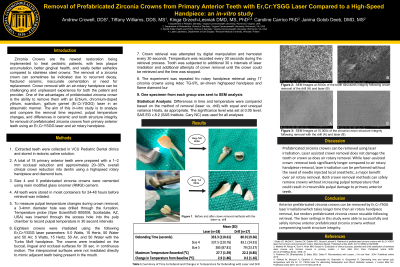
Methods: This in-vitro study used extracted primary incisors. Teeth were prepared and restored with NuSmile zirconia crowns (sizes 4 and 5) cemented with resin-modified glass-ionomer cement. Crowns were removed using either an air-rotary handpiece (HG, N=17) or Er,Cr:YSGG laser (LG, N=18). Pulpal temperature and removal times were compared between the two groups. Following crown removal, one tooth and crown from each group was submitted for SEM examination.
Results: The average time for crown removal for HG was 80.9 seconds (SD=19.36); and 353.3 seconds (SD=110.6) for LG. Removal with the laser took significantly longer by an average of 272.4 (95% CI: 216.8-328.0, p-value < 0.0001) and had higher variability than the drill. The maximum observed temperature for HG was 22.2⁰C (SD=0.85) compared to 27.7⁰C (SD=1.60) for LG. Laser-assisted crown removal was associated with a maximum temperature 5.5⁰C (95% CI: 4.6-6.4) higher than that with the handpiece (p-value < 0.0001).
Conclusions: Er,Cr:YSGG laser and rotary handpiece can both be used predictably to remove zirconia crowns from primary anterior teeth. While a rotary handpiece presents a more efficient method of removal, Er,Cr:YSGG laser offers a viable alternative method.