
.png)
Restorative

Sederic Grant, DDS
Resident
University of Minnesota, Minneapolis, MN
University of Minnesota - Twin Cities
MINNEAPOLIS, Minnesota, United States

Elise L. Sarvas, DDS, MSD, MPH
Clinical Associate Professor
University of Minnesota
University of Washington
Minneapolis, Minnesota, United States

Jeff Karp, DMD, MS
Clinical Associate Professor and Director, Pediatric Dentistry Residency Program
University of Minnesota School of Dentistry
School of Dentistry , University of Minnesota
Minneapolis, Minnesota, United States
Background
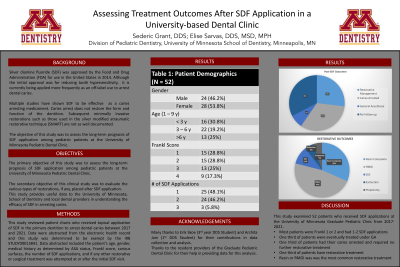
Silver diamine fluoride (SDF) was approved by the Food and Drug Administration (FDA) for use in the United States in 2014. SDF was approved for reducing tooth hypersensitivity, though it is currently being applied more frequently as an off-label use to arrest decay. Current studies substantiate SDF efficacy as a caries arresting medicament. There are a few studies assessing the effectiveness of the silver modified atraumatic restorative technique (SMART) approach. However, the long-term follow-up of patients treated with SDF application in the literature usually uses caries arrest as an outcome, not the success rates of subsequent restorations placed. The objective of this study was to assess the long-term prognosis of SDF applications among pediatric patients at the University of Minnesota Pediatric Dental Clinic.
Methods
This study reviewed patient charts who received topical application of silver diamine fluoride (SDF) solution in the primary dentition to arrest dental caries between 2017 and 2021. Data were abstracted from the electronic health record and this study was determined to be exempt by the IRB STUDY00013841. Data abstracted included the patient’s age, gender, medical history as determined by ASA status, Frankl score, carious surfaces, the number of SDF applications, and if any other restorative or surgical treatment was attempted at or after the initial SDF visit.
Results
This study examined 50 patients who received SDF applications at the University of Minnesota Graduate Pediatric Clinic from 2017-2021. Patients ranged in age from 1 to 9 years of age and 52% were male and 48% were female. The number follow-up appointments for SDF applications range from one to four visits. Clinical data were reported as descriptive statistics. Type and outcome of restorative or surgical treatments after SDF placement were described.
Conclusion
SDF is an important tool for pediatric dentists to arrest dental caries. Follow up of restorations or surgical care post-SDF placement can help inform decision making processes. More research is needed on long term outcomes post-SDF placement.