
.png)
Practice Management
Descriptive Analysis of the Emergency Calls of the UMN Graduate Pediatric Dental Clinic

Mary Tran-Wexler, DDS
Pediatric Dental Resident
University of Minnesota, Minneapolis, MN
Minneapolis, Minnesota, United States

Elise L. Sarvas, DDS, MSD, MPH
Clinical Associate Professor
University of Minnesota
University of Washington
Minneapolis, Minnesota, United States

Jeff Karp, DMD, MS
Clinical Associate Professor and Director, Pediatric Dentistry Residency Program
University of Minnesota School of Dentistry
School of Dentistry , University of Minnesota
Minneapolis, Minnesota, United States
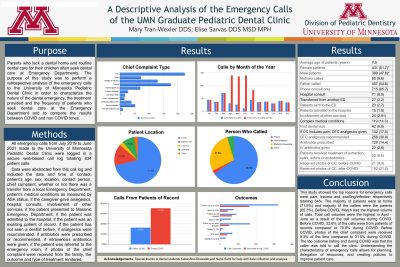
Background: Parents who lack a dental home and routine dental care for their children often seek dental care at Emergency Departments. This study retrospectively analyzed the emergency calls to the University of Minnesota Pediatric Dental Clinic to characterize the nature of the dental emergency, the treatment provided and the frequency of patients who seek dental care at the Emergency Department.
Methods: All emergency calls to the University of Minnesota Pediatric Dental Clinic were logged in a secure web-based call log. Data were abstracted from this call log and included the date and time of contact, patient’s age, sex, location, contact person, chief complaint, whether or not there were transferred from a local Emergency Department, patient’s medical conditions as measured by ASA status, any medications given, hospital consults, involvement of other services, if the patient was admitted to the hospital, if the patient was an exisiting patient of record, if the patient has not seen a dentist before, if analgesics were recommended, if antibiotics were prescribed, if intravenous antibiotics were given, if the patient was referred to the emergency room, if photos of the chief complaint were received from the family, and the type and outcome of treatment rendered.
Results: Eight hundred twenty-eight patient calls were analyzed from the call log from July 2019 to June 2021. Data were reported as descriptive statistics including the proportion of calls for the type of chief complaint and outcomes, the frequency of calls by the month of the year and day of the week and the frequency of patients who seek dental care at the Emergency Department.
Conclusion: Understanding the characteristics of patients that present to the Emergency Department allows on-call services to plan, delegate resources, and create policies to improve patient care.