
.png)
Other

Linda Lavadia, DMD
Pediatric Dental Resident
University of Florida —Gainesville and Naples, Naples, FL
University of Florida
Naples, Florida, United States
Maria Davila Gonzalez, DDS, MPH, DrPH
University of Florida
Kelly Magher, DMD
University of Florida —Gainesville and Naples, Naples, FL
Naples, Florida, United States
Kelly Magher, DMD
University of Florida —Gainesville and Naples, Naples, FL
Naples, Florida, United States
Abimbola O. Adewumi, DDS
Program Director
Florida
Gainesville, Florida, United States
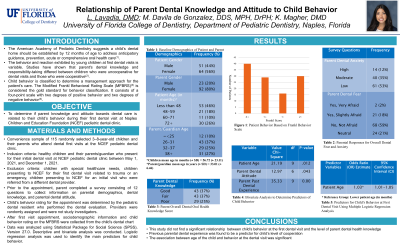
Purpose: The present study aimed to determine if parent oral health knowledge and attitude towards dental care wasrelated to their child’s behavior during their first dental visit.
Methods: The parents of healthy children ages 3 to 8 years old attending first dental visits at the University of Florida/Naples Children and Education Foundation Pediatric Dental Center were invited to complete a 12 question survey regarding parent oral health knowledge and their attitudes and experiences toward dental care prior to their child’s appointment. Following the first visit appointment, sociodemographic information and child behavior rating on the modified Frankl behavior rating scale was collected from the child’s dental chart.
Results: One hundred and fifteen parents agreed to participate in the study. Mean age of children was 56.7 (±23.1) months. Multivariate regression analysis indicated there was no significant difference between a child’s behavior and the parent oral health knowledge (P>.005). There was a significant relationship between parent's past dental experience (P < .005) and parental attitude toward dental care (P =.043) and their child’s behavior. There was a significant association between age of the children and behavior (P =.004).
Conclusions: The results demonstrated that the level of parent dental health knowledge did not affect their child’s behavior at their first dental visit in this study. Previous parental dental experience was found to be a predictor of a child’s level of cooperation during a first dental visit. The association between age of the child and behavior at the dental visit was in agreement with previous studies.