
.png)
Growth & Development


Olga Yampolsky, DDS
Pediatric Dental Resident
Staten Island University Hospital, New York, NY
Brooklyn, New York, United States
Rachel Iospa, DMD
Director, Pediatric Dentistry Residency Program
Staten Island University Hospital
staten Island, New York, United States
Purpose: To discuss diagnosis and management of dens invaginatus in mixed dentition with an emphasis on early diagnosis and preventive measures to minimize complications.
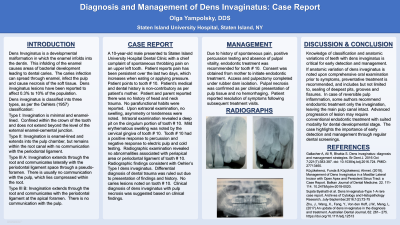
Dens invaginatus is a developmental malformation in which the enamel infolds into the dentine. This infolding of the enamel causes areas of bacterial development leading to dental caries. The carious infection can spread via enamel, infect the pulp and cause necrosis of the soft tissue. Dens invaginatus lesions have been reported to affect 0.3% to 10% of the population.
The purpose of this paper is to present a case report of a 10-year-old male patient presenting with dens invaginatus on upper left lateral incisor. The patient presented to the dental clinic with chief complaint of spontaneous throbbing pain on upper left lateral incisor (tooth # 10). Medical and family history is non-pertinent. During extraoral examination, no swelling, asymmetry and tenderness was observed. Intraoral examination revealed mild vestibular erythematous swelling adjacent to tooth #10 along with grade II mobility, tooth #10 is positive to percussion with no evidence of carious lesion. Pronounced talon cusp was observed. Radiographic examination revealed radiolucent pocket under the cingulum with no periapical pathology. Differential diagnosis of dens invaginatus versus dental trauma based on clinical and radiographic examination was performed. Treatment approach consists of antibiotic therapy and mechanical debridement of tooth #10. Root canal therapy is indicated if symptoms—throbbing pain, sensitivity to percussion and palpation—persist.