
.png)
Sedation

Kelly Plote, DDS
Pediatric Dental Resident
University at Buffalo/Women and Children’s Hospital of Buffalo, Buffalo, NY
University at Buffalo
Williamsville, New York, United States
Kyung Ah Chung, DMD
University at Buffalo
Allana Langen, Bachelor's of Science, Sociology and English
University Pediatric Dentistry
Jonathan Malinovsky, BS
University Pediatric Dentistry

Christopher Heard, MD
Attending Anesthesiologist
University at Buffalo
Buffalo, New York, United States
Christopher Heard, MD
Attending Anesthesiologist
University at Buffalo
Buffalo, New York, United States
Carrie Wanamaker, DDS, DDS
Program Director, Advanced Education in Pediatric Dentistry
University at Buffalo
Buffalo, New York, United States
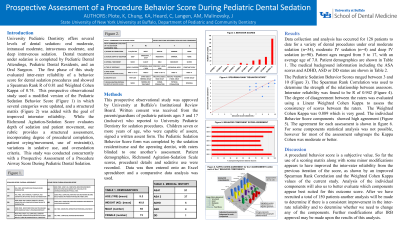
Purpose: This prospective observational study used a modified version of the Pediatric Sedation Behavior Score previously reported to the AAPD in 2021. Several categories were updated, and a structured answer matrix to improve inter-rater reliability was added. While the Richmond Agitation-Sedation Score evaluates depth of sedation and patient movement, our rubric provides a structured assessment plan, incorporating degree of procedural completion, patient crying/movement, use of restraint(s), variations in sedative use, and oversedation criteria.
Methods: This research was approved by University at Buffalo Institutional Review Board. A total of 500 patients between the ages of 3 and 17 will be recruited. Pediatric Sedation Behavior Scoring was assessed by the sedation resident/nurse and the operating dentist, with raters blinded to one another’s assessment. Data was gathered for all types of sedation over a wide scope of dental procedures. Demographics, procedural details and scores were collected, and comparative data analysis will be used.
Results: Data collection has occurred for 34 patients to date;17 deep sedation oral surgery patients, 11 deep sedation pediatric dental procedure patients, and 6 patients were seen for oral conscious sedation patients. Behavior scores ranged between 9 - 10. Assessor 1 and Assessor 2 Behavior Scores ranged between 6 - 10 and 7 - 10, respectively.
Conclusion: Interrelater reliability will be reassessed after an additional 100 patients are evaluated. We expect to improve upon the Spearman Rank R of 0.81 and Weighted Cohen Kappa of 0.74 originally achieved.