
.png)
Trauma

Hana Reed, DMD
Resident
Indiana University School of Dentistry
Indiana University
Brownsburg, Indiana, United States

James E. Jones, DMD, PhD, EdD, MSD, MA
Faculty
Indiana University School of Dentistry, Indianapolis, Indiana - Riley Hospital for Children
Indianapolis, Indiana, United States
Juan F. Yepes, DDS, MD, MPH, MS, DrPH, FDS, RCDS(Ed)
Professor in the Department of Pediatric Dentistry
Indiana University School of Dentistry
Indiana University -Riley Children Hospital-
Indianapolis, Indiana, United States
James E. Jones, DMD, PhD, EdD, MSD, MA
Faculty
Indiana University School of Dentistry, Indianapolis, Indiana - Riley Hospital for Children
Indianapolis, Indiana, United States
LaQuia A. Vinson, DDS, MPH
Pediatric Dentistry Residency Program Director
Indiana University School of Dentistry
Indianapolis, Indiana, United States
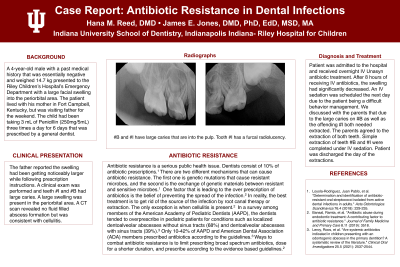
Introduction: Antibiotic-resistant infections that require the use of second-and third-line treatments can cause serious side effects such as organ failure, prolonging care and recovery. It has become a major public health issue. More and more infections are caused by resistant bacteria and are no longer responsive to conventional treatment. A problem contributing to antibiotic resistance is that broad spectrum antibiotics are too commonly used. The bacteria of the oral flora are becoming increasingly more resistant. Two different processes have been observed that contribute to bacterial resistance. These processes include developing a gene mutation and exchanging mutations among bacteria.
Case Report: A 3-year-old male, weighing 14.7 kg, presented to Riley Children’s Hospital’s emergency department with a large left facial swelling including the orbital area. The patient lived with his mother in Fort Campbell, Kentucky, but was visiting his father for the weekend. The child had been taking 3 mL of Penicillin (250 mg/5mL) three times a day for 6 days that was prescribed by a general dentist. The father reported the swelling had been getting noticeably larger while following prescription instructions. Due to the increasing extent of facial swelling, the patient was admitted for IV antibiotics. Radiographs revealed #I was the offending tooth, although #B also had large caries. The following day the hospital sedation team provided IV sedation, using ketamine, for extraction of #B and #I. This was accomplished without complication. This report will include photographic and radiographic findings, specifics of treatment and follow-up care.