
.png)
Other

Ilana Kramer, DDS
PGY1
University of Illinois Chicago
University of Illinois Chicago
Chicago, Illinois, United States
Muna Hakim, BDS, DDS, MBA
University of Illinois Chicago
Brittaney J. Hill, DDS, MS, MPH
Clinical Assistant Professor of Pediatric Dentistry
University of Illinois at Chicago, Chicago, IL
University of Illinois at Chicago
Chicago, Illinois, United States
Rebecca Van Horn, RDH
University of Illinois Chicago
.jpg "David M. Avenetti, DDS, MSD, MPH photo")
David M. Avenetti, DDS, MSD, MPH
Associate Professor & Residency Program Director
University of Illinois Chicago, College of Dentistry
University of Illinois Chicago, Dept. of Pediatric Dentistry
Chicago, Illinois, United States
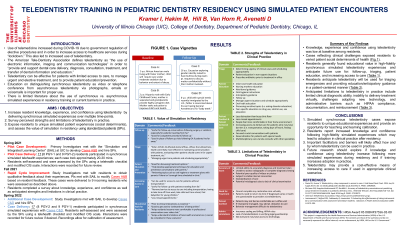
Purpose: Teledentistry became widely used during the COVID-19 pandemic and may offer means of improving access to care; however, best practices for teaching and implementing teledentistry in pediatric dentistry residencies are evolving. The purpose of this pilot study was to develop and deliver simulated patient interactions, improve residents’ knowledge and confidence using Teledentistry, and identify resident-reported facilitators and challenges for implementation in clinical practice.
Methods: In Spring/Fall 2021, eighteen residents piloted simulated synchronous teledentistry encounters using standardized patients. Cases focused on patient education/motivational interviewing rather than clinical assessments. Residents provided qualitative feedback about the simulated experiences and the strengths/weaknesses of using synchronous teledentistry in clinical practice. Simulations were recorded for future resident self-assessment and faculty calibration.
Results: 18 residents completed a total of 36 simulations through the Simulation and Integrated Learning Center (UIC, Chicago, IL). Residents reported no prior experience with synchronous teledentistry and only prior experience using asynchronous screening for emergency patients. Residents were unfamiliar with best practices for use of telemedicine (i.e., introductions, clarifying visit goals, affirming privacy, goal setting) and reported increased comfort with teledentistry following the patient encounters. Residents highlighted the limitation that teledentistry will not likely replace pediatric clinical oral examinations.
Conclusion: Simulated teledentistry experiences may improve residents’ knowledge and confidence while offering a mechanism for calibrating learning experiences and resident assessment. Use of teledentistry may be limited to specific appointment types; however, access to care may be expanded for high-risk populations, who may benefit from non-clinical visits (patient education/motivational interviewing).