
.png)
Other


Nicholas A. Tai, DDS
Pediatric Dental Resident
New York University, New York, NY
New York University College of Dentistry
Ridgewood, New Jersey, United States
Rose J. Amable, DDS, DABPD
New York University College of Dentistry
New York, New York, United States
Lauren Feldman, DMD
Postdoctoral Program Director
New York University
New York, New York, United States
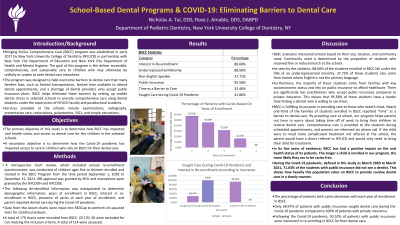
Purpose: The purpose of this study is to evaluate access to dental care and oral health status for NYC elementary school children (ages 5-12) treated in two school-based dental programs overseen by New York University College of Dentistry (NYUCD) Bringing Smiles Comprehensive Care (BSCC). Variables assessed include re-enrollment in the dental program, barriers to dental care, pending dental treatment, referral, and the impact of the COVID-19 pandemic.
Methods: A retrospective cohort study was conducted to evaluate patients enrolled and treated in two BSCC school-based dental programs. The study population consisted of elementary school children 5-12 years old who enrolled in the BSCC program from September 1st, 2018 to December 31st, 2021. Approximately, 95 charts, with no identifiers, were reviewed to analyze demographics, years of enrollment, interest in re-enrollment, parental perceived barriers to care, impact of COVID-19 in obtaining dental care, and oral health status in every year enrolled.
Results: The longer a child is enrolled in our program, the more likely they are to be caries free (57.02% of patients had caries during their first year of enrollment, and 0.00% of patients had caries after being enrolled for five years). During the Covid-19 pandemic, defined in this study as March 2020 to March 2021, 71.03% of the students with public insurance did not see a dentist. This shows how heavily this population relies on BSCC to provide routine dental care in a timely manner.
Conclusions: In its five years of existence, BSCC has had a positive impact on the oral health status of its patients, and patients continue to enroll at a rate of almost 90% each year. BSCC helps make dental care more accessible for its patients of whom a majority are under-represented minorities (88.60%) and have public insurance (95.58%).