
.png)
Sedation

Karl B. Klingler, DDS
Pediatric Dental Resident
University at Buffalo/Women and Children’s Hospital of Buffalo, Buffalo, NY
University at Buffalo
Williamsville, New York, United States
Allana Langen, Bachelor's of Science, Sociology and English
University Pediatric Dentistry
Chris Heard, MD
University at Buffalo

Christopher Heard, MD
Attending Anesthesiologist
University at Buffalo
Buffalo, New York, United States
Carrie Wanamaker, DDS, DDS
Program Director, Advanced Education in Pediatric Dentistry
University at Buffalo
Buffalo, New York, United States
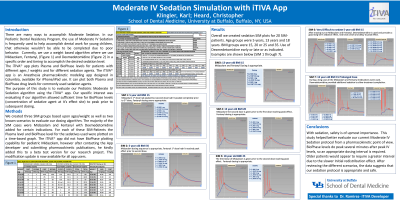
Purpose: This research uses an anesthesia pharmacokinetic modeling application to evaluate University Pediatric Dentistry’s moderate intravenous sedation algorithm. Ideally, each medication achieves its maximum effect before another is administered; this application allows us to study the plasma and biophase levels of sedatives and observe how they are affected by various factors.
Methods: This research was exempt from Institutional Review Board approval. Simulated patients were created and categorized based on age, body mass index, and dosing regimens. Each age group was split into three subgroups based on body mass index. Plasma and biophase levels for the sedation scenarios are being plotted on a time-based graph using the iTIVA application. The times in which patients reach peak drug effect will be aggregated. The sedatives simulated were midazolam, fentanyl, and dexmedetomidine.
Results: Thirty-six simulated scenarios have currently been plotted for 13- and 18-year-old patients. Data collection is ongoing and will study a total of 54 scenarios, to include 5-year-old patients. Plasma and biophase levels for the respective sedative regimens, as well as peak drug effect times, will be recorded and analyzed.
Conclusions: The iTIVA application provides a limited, but valuable, glimpse into how moderate intravenous sedation occurs in pediatric patients. The effects of age, body mass index, and drug combinations can be studied without risks to patients. Although our current regimen provides effective and safe sedation, the results may provide the opportunity to improve our care further.