
.png)
Other


Daniel M. Walsh, DMD
Chief Dental Resident
University of Washington, Seattle, WA
University of Washington, Seattle, WA
Seattle, Washington, United States
Barbara Sheller, DDS, MSD
Division Chief, Pediatric Dentistry
Seattle Children's Hospital
Seattle, Washington, United States
Bryan Williams, DDS, MSD
Seattle Children's Hospital
Anne Reeves, DDS, MPH
Seattle Children's Hospital
Barbara Sheller, DDS, MSD
Division Chief, Pediatric Dentistry
Seattle Children's Hospital
Seattle, Washington, United States
.jpg "Travis M. Nelson, DDS, MSD, MPH photo")
Travis M. Nelson, DDS, MSD, MPH
Associate Professor & Chair, Pediatric Dentistry
University of Washington, Seattle, WA
University of Washington
Seattle, Washington, United States
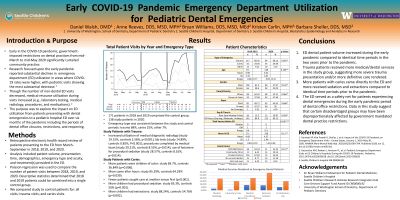
Purpose: Early in the COVID-19 pandemic, government-imposed restrictions on dental practices from mid-March to mid-May 2020 effectively curtailed community practice. We analyzed utilization of a pediatric hospital emergency department (ED) for dental emergencies over six months including dental office closures and reopening, compared to two previous years.
Methods: Records of patients presenting to the ED were analyzed for: volume, presentation time, demographics, dental emergency type and acuity, and treatment(s) provided in the ED. Study patients presented 3/15-9/15/2020; control patients presented 3/15-9/15/2019 and 3/15-9/15/2018.
Results: 138 study patients (mean age 6.4 years) and 171 controls (80 from 2018, 91 from 2019, mean age 7.0 years) were assessed. Emergency types were trauma 68%, caries 25%, and other 7% for both time periods (P=.997). Increased ED resource use for trauma patients in 2020 included suturing (P=.014), intravenous sedation (P=.014), and medical radiology (P < .001). Differences for 2020 caries patients were: more presented during weekday business hours (P=.039), more identified as persons of color (P=.006), fewer saw their dentist prior to ED presentation (P=.024), more received sedation (P=.001), and more received definitive care in the ED (P=.002).
Conclusions: Provision of care to patients with dental emergencies heightened utilization of ED resources early in the COVID-19 pandemic. Trauma patients consumed more ED services, reflecting both increased trauma severity and decreased use of the ED for minor trauma. Restricted community access to dental care disproportionally affected children of color with caries emergencies; ED presentation during weekday business hours suggests that their usual dental providers were unavailable.