
.png)
Pulp Therapy


Erika Peters, DMD
Resident
University of Illinois Chicago College of Dentistry
University of Illinois Chicago College of Dentistry
Chicago, Illinois, United States
.jpg "Evelina Kratunova, MDS, MFD, D.Ch.Dent., FFD photo")
Evelina Kratunova, MDS, MFD, D.Ch.Dent., FFD
Clinical Assistant Professor
University of Illinois at Chicago
College of Dentistry, University of Illinois at Chicago
Chicago, Illinois, United States
Satish B. Alapati, PhD, DDS
University of Illinois at Chicago College of Dentistry
Sahar Alrayyes, DDS, MS
Department of Pediatric Dentistry, College of Dentistry, UIC Chicago, IL,
Flavia Lamberghini, DDS, MS, MPH, FAAPD
UIC Clinical Associate Professor
University of Illinois at Chicago College of Dentistry
University of Illinois at Chicago, Department of Pediatric Dentistry
Chicago, Illinois, United States
Flavia Lamberghini, DDS, MS, MPH, FAAPD
UIC Clinical Associate Professor
University of Illinois at Chicago College of Dentistry
University of Illinois at Chicago, Department of Pediatric Dentistry
Chicago, Illinois, United States
.jpg "David M. Avenetti, DDS, MSD, MPH photo")
David M. Avenetti, DDS, MSD, MPH
Associate Professor & Residency Program Director
University of Illinois Chicago, College of Dentistry
University of Illinois Chicago, Dept. of Pediatric Dentistry
Chicago, Illinois, United States
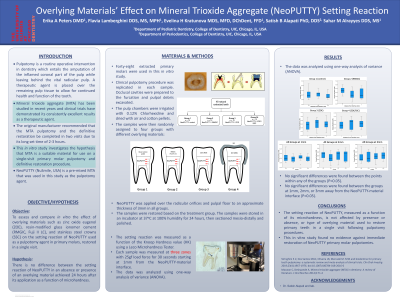
Purpose: To assess and compare in vitro the effect of overlying materials such as zinc oxide eugenol (ZOE), resin-modified glass ionomer cement (RMGIC), and stainless steel crowns (SSC) on the setting reaction of NeoPUTTY used as a pulpotomy agent in primary molars, restored in a single visit.
Methods: Forty-eight extracted primary molars were prepared with standard pulpotomy technique. Approximately 3mm of NeoPUTTY was placed on the pulpal floor. The teeth were divided into 4 groups: (1) control group – moist cotton pellet placed over NeoPUTTY, no material applied over MTA, (2) RMGIC applied, (3) ZOE applied, (4) ZOE and SSC applied. Groups 2, 3, 4 were placed in artificially simulated oral cavity conditions. After 24h all teeth were sectioned mesio-distally, polished and microhardness was measured in Knoop Scales (HK) at 1mm, 2mm, 3mm away from NeoPUTTY-overlying material interface following application of a 25gf load force for 30 seconds at each site. One-way ANOVA was used to compare hardness values between groups at each depth (P < .05). Repeated-measures ANOVA was used to compare hardness values between depths within each group (P < .05).
Results: No statistically significant differences in mean HK values were found between groups at each depth, or between depths within each group.
Conclusions: The setting reaction of NeoPUTTY, measured as a function of its microhardness, was not affected by presence or absence, or type of overlying material used in a single visit pulpotomy. This in vitro study found no evidence against immediate restoration of NeoPUTTY primary molar pulpotomies.