
.png)
Pulp Therapy


Sumedha Sharma, DMD
Pediatric Dentistry Resident
University of Texas Health Science Center at Houston
UT Houston School of Dentistry
Houston, India
Lubna Fawad, DDS
University of Texas Health Science Center at Houston School of Dentistry
Gregory Olson, DDS, MSc
University of Texas Health Science Center at Houston
Anibal Diogenes, DDS, MS, PhD
UT San Antonio
Julie Schiavo, MLIS, AHIP
LSU, New Orleans
Nitesh Tewari, MDS, FIADT
AIIMS, India
Priyanshi Ritwik, BDS, MS
Professor
University of Texas Health Science Center at Houston
Houston, Texas, United States

Brett T. Chiquet, DDS, PhD
Associate Professor Non-Tenure Clinical
University of Texas Health Science Center at Houston School of Dentistry
University of Texas School of Dentistry
Houston, Texas, United States
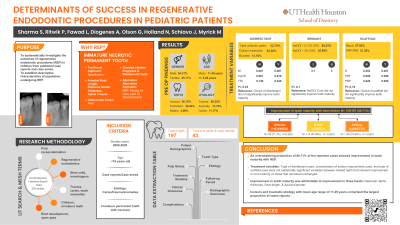
Purpose: This project aimed to systematically investigate the outcomes of regenerative endodontic procedures (REP) in pediatric patients from published scientific case reports and case series. Parameters pertinent to pediatric patients, namely tooth maturity, patient age, therapeutic protocols, and follow-up duration were identified as variables of interest. Clinical and radiographic outcomes of interest were tabulated as successful or unsuccessful. This study also extracted the distribution and characteristics (clinical and radiographic) of success and failure of REP in pediatric patients from the included cases.
Methods: A comprehensive literature search for articles between the years 2000-2020 was carried out in Pubmed using the keywords pulp revascularization, regenerative endodontics, pulp revitalization, stem cells, immature teeth, root development, child. The search was limited to case reports, case series, and clinical trials. The search was conducted by a reference librarian. The search yielded a total of 225 articles. Inclusion criteria as follows were applied to the search results: a) pediatric patients under 16 years of age b) 6 months or greater follow up c) application of REP technique to the permanent tooth. Data from included cases and case series was extracted by three researchers into a spreadsheet. Extracted data was broadly categorized as a) patient parameters b) tooth parameters and c) outcomes. Patient and tooth parameters were correlated with outcomes of REP to assess which are statistical predictors of favorable outcomes.
Results: Pending
Conclusion: Pending